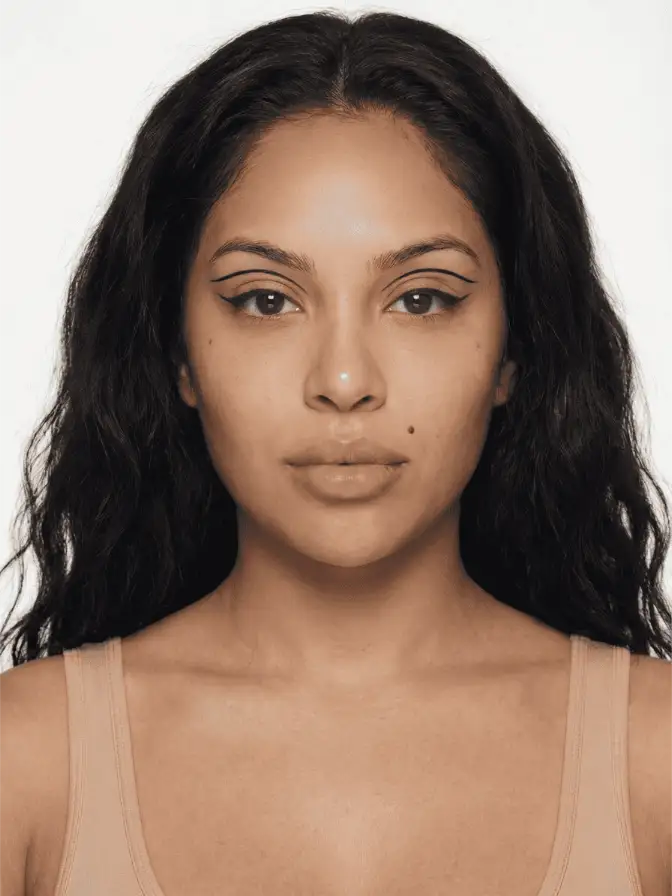
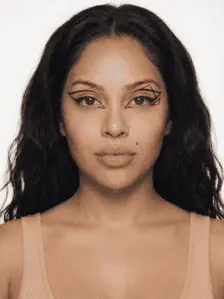
Pat McGrath's floating liner, from Valentino to Bottega
The floating liner McGrath painted at Valentino in 2022 became the most copied editorial eye of the decade. Tracing the line from runway to TikTok to SS26.
The first version was at Valentino, July 2022, the Spring 2023 haute couture show in Rome. The line was thin, painted in matte black, and sat about a centimeter above the natural crease. It connected to nothing. It pointed at nothing. Pat McGrath painted it on every model who walked, and within three days the search term “floating liner” had spiked on TikTok by a factor of eleven.
Four seasons later, McGrath put the same construction on Bottega’s SS26 runway in September. The line had migrated to a deep oxblood pigment and was now paired with a high-shine vinyl lip. The face had simplified around it. The eye was carrying the look, but the line was the eye.
This is the trajectory of a single editorial eye over three and a half years, and the way it has rearranged the contemporary vocabulary of makeup.
The technical choice
A floating liner is a graphic line drawn above the natural crease, hovering in the open lid space, deliberately not touching the lash line below or the brow bone above. The construction was not invented at Valentino. McGrath’s archive includes a similar floating shape at the John Galliano Dior shows of the early 2000s, in heavier pigment and with more drama. The 2022 version was thinner, cleaner, and read as architectural rather than theatrical.
The reason it works in a still image is geometric. The eye has two horizontal landmarks: the lash line and the brow. A liner that occupies neither and instead introduces a third horizontal creates an unfamiliar visual weight in the center of the face. The image becomes harder to read at a glance, which is exactly what an editorial eye is supposed to do. The viewer slows down. The picture holds attention.
The reason it works on a runway in motion is different. As a model blinks, a traditional cat-eye winged liner compresses and expands with the eyelid. The wing reads as part of the eye. A floating liner, painted on the upper movable lid above the crease fold, partially disappears on a blink and re-emerges on the open eye. This produces a flicker effect that catches the runway photographer’s attention frame by frame.
McGrath told Runway Live’s graphic liner roundup that the floating construction was specifically designed to translate from runway to social. The flicker, she said, was the photographable element.
The spread, week by week
Within seventy-two hours of the Valentino show, makeup artists Mikayla Nogueira and Robert Welsh both posted floating-liner application breakdowns. Welsh’s video used a small flat liner brush and gel pigment. Nogueira’s used a felt-tip liquid liner pen and a piece of scotch tape as a guide. Both videos crossed five million views within ten days.
By October 2022 the trend had moved off TikTok and into bridal makeup. Wedding stylists in Mumbai and Lagos posted client work with the floating line incorporated into Arabian and Bollywood glam traditions, where graphic liner has its own much older lineage. The McGrath construction sat naturally inside those traditions because it shared the same underlying principle: pigment placed deliberately outside the natural eye shape to add weight.
By February 2023 the line had appeared in the New York shows. By June 2023 it was on red carpets. By the SS24 calendar in September 2023 McGrath revisited the construction at Schiaparelli, painted in copper rather than black and angled more sharply at the outer corner. The original Valentino version had become a reference point. Every subsequent runway eye that floated above the crease was being graded against it.
The Bottega arrival
By the time SS26 came around in September 2025, McGrath had painted floating-liner variations at four houses across three seasons. The Bottega version, captured in Hypebae’s runway coverage, pulled all the threads together.
The line was the deep matte oxblood McGrath had been quietly bringing back to lip color for two seasons. The shape was the same thin floating construction. The placement, this time, was slightly lower than the original Valentino version, sitting just above the upper lash line rather than mid-lid. The change, almost imperceptible in still photographs, made the eye read closer to a traditional liner construction at first glance and only revealed its floating character on the blink.
This is McGrath’s signature move across her career: take an editorial language she has helped invent, simplify it until it reads as accessible, then redeploy it in a context where the original version would have been too aggressive. The Bottega floating liner read as wearable. The Valentino version, three and a half years earlier, did not.
Pat McGrath’s Schiaparelli SS26 work, also captured in Hypebae’s October coverage, pulled the same construction in the opposite direction. There the line was bright, glittered, and pushed back up to its original mid-lid position. The two shows together, in the same Paris fashion week, framed the full range of where a floating liner could live.
The lineage and the influence
W Magazine’s archive of McGrath’s most memorable runway looks traces her career across roughly three decades, from the early Galliano shows in the late 1990s through Margiela, Versace, and the more recent McQueen and Bottega work under Daniel Sander and Daniel Lee. The floating liner is now embedded in that archive as one of her defining contributions.
It sits alongside two other McGrath-coded looks: the metallic golden eye she developed for the Galliano Dior shows of 2003, and the heavy graphic gloss she pioneered for the McQueen shows of the early 2000s. Each construction has filtered down through other makeup artists and become part of the shared vocabulary of editorial makeup. Each was unrecognizable when McGrath first painted it. Each is now copied weekly on TikTok by twenty-year-olds who have no idea where it came from.
This is what an influential editorial career looks like in the makeup industry. The artist invents a construction, the construction reads as foreign for two seasons, then it migrates into the broader vocabulary and is no longer attributed. The line on Bottega’s SS26 runway will be on the inner-corner graphic liner tutorials of 2027 with no credit to McGrath at all. That has always been the cost of the influence. McGrath does not seem to mind. The line is the work. Whose name is attached to it is, to her, beside the point.
What it means for the season
The floating liner will continue to spread through 2026 because it photographs well on phone cameras and reads as serious on a face that has otherwise been minimized. The pairing with the bare-radiance skin finish of the SS26 season is structurally sound: when the rest of the face has stepped back, the eye has space to step forward.
Expect a wave of mass-market floating-liner products: thin felt-tip pens at Maybelline and L’Oreal, shaped guides at Sephora private label, and at least one Pat McGrath Labs branded pen kit by the holiday gift season. The construction is now generic enough to be productized. McGrath has, in effect, finished her work on it. The next floating shape she paints will be something else entirely. She is already several seasons ahead.
Continue reading
- inspiration Peter Philips: from a Mickey Mouse face to Dior Beauty The graphic-design student who painted Mickey on a model at a Raf Simons shoot went on to run the two most coveted jobs in cosmetics. A profile.
- inspiration Val Garland: The Colorist Who Rewrote the Rules From a Bristol hair salon to the first global makeup director at L'Oreal Paris, Val Garland built a career on refusing the rulebook. A profile of an editorial original.
- inspiration The End of Precision: Why 2026 Makeup Loosened Up For a decade makeup chased Instagram precision. The 2026 runways rewarded a deliberately imperfect hand instead, and that loosening says something about us.