Val Garland: The Colorist Who Rewrote the Rules
From a Bristol hair salon to the first global makeup director at L'Oreal Paris, Val Garland built a career on refusing the rulebook. A profile of an editorial original.
Val Garland did not set out to be a makeup artist. She started behind a chair, mixing hair color in Bristol, and the thing that eventually made her one of the most recognizable faces in fashion beauty was not a technique. It was a refusal to do things the correct way.
“I don’t like to follow rules,” she told Dazed in a 2017 interview, and the line could serve as her entire biography. The work backs it up.
A long way around to the face
Her path reads nothing like a straight line. Garland trained as a hair colorist, then relocated to Sydney, where, as her Streeters agency biography records, a fascination with color pulled her out of hair and into makeup. She built a reputation in Australia first, working it out as she went, before returning to London in 1994 to start over in a more demanding market.
That late, sideways entry matters. Garland was not a prodigy who had been blending shadow since she was twelve. She came to makeup as someone who already understood color from the chemistry side, from years of formulating dye, and who treated the face as another surface to be painted rather than a set of features to be flattered. The Fashionista profile of her career frames the whole arc as exactly that: teen hairstylist to one of fashion’s most well-known makeup artists, with no shortcut in between.
Editorial, not pretty
London in the 1990s was the right place for someone allergic to rules. Garland landed in the orbit of the photographers and stylists building the decade’s harder, stranger fashion imagery, and she became a fixture of it.
Her client list reads like a syllabus of modern fashion. She worked the runways for Alexander McQueen and Vivienne Westwood, the two designers least interested in conventional prettiness, and shot with Nick Knight, Craig McDean, and Tim Walker for Vogue, Dazed, and Harper’s Bazaar. She built looks for Kate Moss and, later, helped Lady Gaga create the face for the Born This Way album cover, the chrome-and-bone aesthetic that defined that era of the artist’s image.
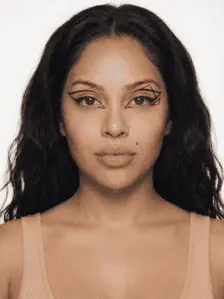
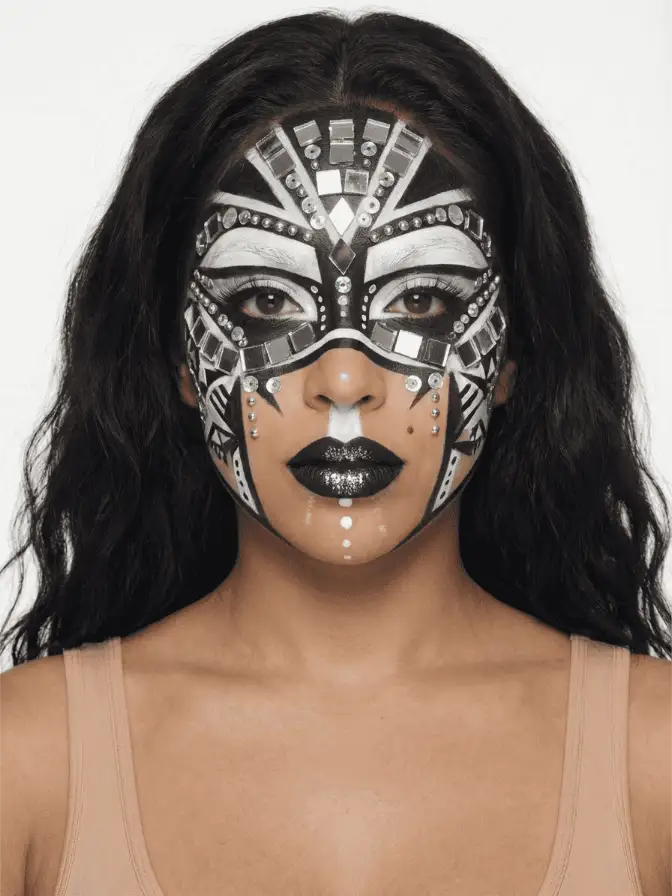
What ties the work together is appetite for risk. Garland’s editorial makeup is frequently not flattering in the cosmetic-counter sense; it is graphic, sometimes grotesque, often built around a single bold idea taken further than good taste would advise. A slash of color where you would not expect one. The same instinct that powers a piece of graphic liner, where the line stops being about defining the eye and starts being a shape in its own right, runs through her runway work at scale.
Color as the whole point
The thread back to that Bristol salon never really breaks. Color is the throughline of everything Garland makes.
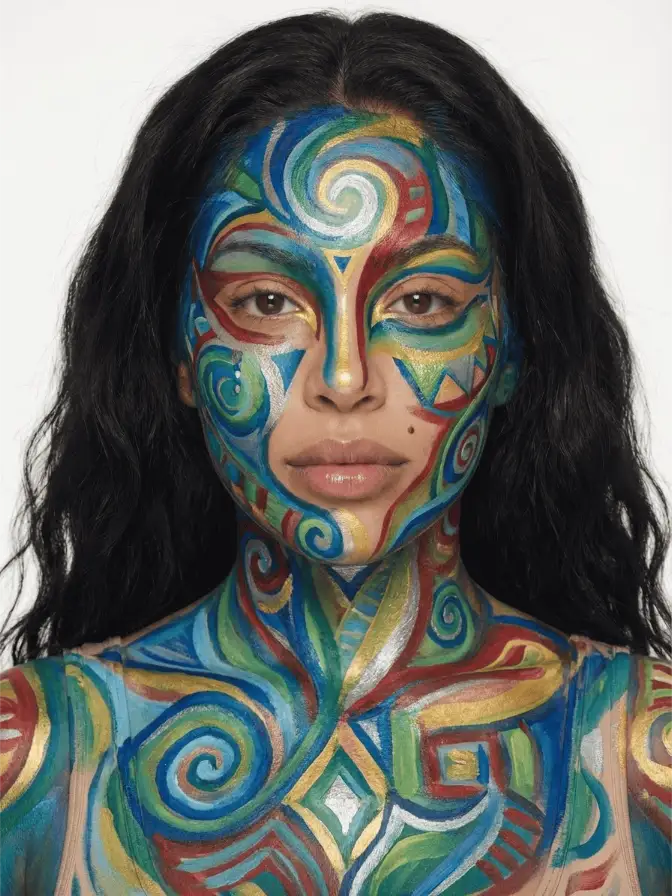
In her hands the face is a canvas in the most literal sense, and the boundary between makeup and paint gets thin. Her editorial stories drift readily into body painting, color carried off the face and across skin as composition rather than cosmetics, the kind of work that has more in common with a studio canvas than a getting-ready routine. It is the logic of a colorist who never fully left, who sees a complexion the way she once saw a head of hair: as something to transform, not correct.
There is a lineage to this. The club-kid and avant-garde scenes that fed 1990s London fashion treated makeup as costume and provocation, and Garland’s sensibility carries that DNA forward into glossy editorial pages. You can see the family resemblance in any club-kid look, where the face becomes a statement of belonging and rebellion rather than an attempt to look conventionally done. Garland took that raw energy and made it sit on the cover of Vogue.
If there is a recurring signature inside all that variety, it is texture used as a shock. Garland will set a flawless complexion and then break it on purpose, a gloss left deliberately tacky, a pigment pressed on with fingers instead of blended out, a wash of color that stops mid-cheek where a tidier artist would diffuse it. The effect keeps an image from looking finished and safe. It is the same impulse that drives her color choices, a sense that the interesting moment is the one just past the point where most people would stop.
Her process is as unbowed as her results. Garland has described working fast and on instinct, building a look in the moment off whatever the photographer and the clothes are doing rather than arriving with a fixed plan, which is part of why no two of her stories look quite alike. Into The Gloss’s account of her career captures that restlessness, a refusal to settle into a single signature, because the signature would itself harden into a rule. The consistency lives in the attitude, not the aesthetic. That is a rarer thing than technical skill, and harder to teach.
Validated, and the second act
By 2017 the industry had caught up to her. That year Garland became the first L’Oreal Paris global makeup director, a role spanning product innovation and brand artistry, which put a self-taught rule-breaker at the creative center of one of the largest cosmetics companies on earth. It is a quietly remarkable outcome for someone who came to makeup late and sideways.
The following year she published Validated, an anthology gathering the most significant images of her career, the title a wink at a life spent ignoring approval and earning it anyway. And in 2019 she joined the BBC competition series Glow Up as a judge, which is where a generation of viewers who will never see a McQueen show first met her: sharp, encouraging, completely unwilling to reward a safe choice.
What an everyday face can borrow
It would be easy to file Garland under “not for me,” the province of runways and album covers and people with three hours and an airbrush. That misreads the lesson.
The transferable thing is not the technique, it is the permission. Garland’s whole career argues that the rules of makeup are conventions, not laws, and that the interesting work starts where the rulebook ends. You do not need to paint a model silver to absorb that. It can be as small as putting blush somewhere the diagram says not to, or letting a liner be a shape instead of a line, or deciding that today the point of your face is one strong idea rather than ten balanced ones.
That permission scales down cleanly. The home version is not a silver face and a studio airbrush; it is a willingness to audit which of your makeup habits are genuine improvements and which are just inherited rules you never thought to question. Why must blush sit on the apples? Why does liner have to hug the lash line? Garland’s answer, across four decades of work, is that none of it has to do anything in particular, and the looks people actually remember are almost always the ones where someone decided a convention was optional and tried the other thing.
A colorist from Bristol built a forty-year career on that single conviction. The makeup is worth studying. The nerve is worth borrowing.
Continue reading
- inspiration Peter Philips: from a Mickey Mouse face to Dior Beauty The graphic-design student who painted Mickey on a model at a Raf Simons shoot went on to run the two most coveted jobs in cosmetics. A profile.
- inspiration The End of Precision: Why 2026 Makeup Loosened Up For a decade makeup chased Instagram precision. The 2026 runways rewarded a deliberately imperfect hand instead, and that loosening says something about us.
- inspiration Danessa Myricks, the Accidental Makeup Artist She taught herself makeup from a magazine job, ran product innovation at Benefit, and built her own brand around the shade gap she lived through as a teen.