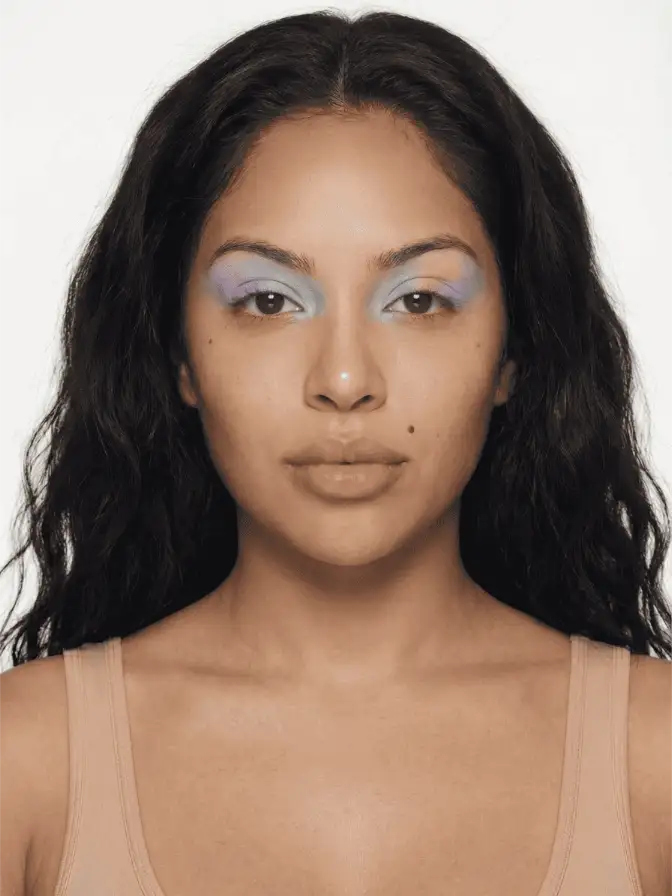
Watercolor eyeshadow: the SS26 wash technique that broke runways
Spring 2026 runways at Collina Strada and Ashish swapped packed pigment for thin transparent washes; here is how the lid diffusion actually works.
At Collina Strada’s Spring/Summer 2026 show in New York, models walked with washes of unrestrained pink across the lid, edges fading into bare skin like a stain someone had blotted halfway. Two weeks later at Ashish in Paris, the same idea hit again in cobalt blue, this time looking like a brushstroke loaded with too much water and pulled across the eye. Who What Wear’s fashion month roundup named watercolor eyeshadow one of seven defining SS26 beauty trends. Istituto Marangoni’s industry report flagged the same thing: eyes were back at the centre of the runway, but in a deliberately diffused register that refused the precision of a cut crease or sharp liner.
The look is not new. Pat McGrath has been blocking colour on test shoots in this register for the better part of a decade, and Lucia Pieroni built half her career on it. What changed in SS26 is that two designers in one season bet a runway moment on it, and now the search volume on watercolor eyeshadow tutorials has roughly tripled.
What watercolor wash actually is on the lid
A watercolor wash is shadow diluted to the point where the pigment scatters across the lid in a thin film instead of sitting in a defined block. The translation off the runway is one of two methods. Backstage at Collina Strada, the team used cream shadow pressed in with a finger and then chased with a damp synthetic flat. The water on the brush loosens the pigment edge, dragging some of the color sideways into bare skin. The result is what you see in close-up shots: a centre of saturated colour and roughly six millimetres of fading wash, no defined boundary anywhere.
The other method is loose pigment mixed with mixing medium or rosewater on a palette, then applied wet with a flat shader. The finish is similar. The loose-pigment route gives slightly more depth because the particles sit on top of the lid instead of melting into it, but it also flakes more, which is why runway shows tend to favour cream.
Why most home attempts go patchy
Two failure modes show up in every tutorial comment thread. The first is muddy concentration in the centre. The second is broken patches at the edges, the wash splitting into little islands of pigment with bare skin between them. Both come from the same root cause: the wrong water-to-pigment ratio.
Too dry and the brush deposits pigment in streaks where the bristles touched down. Too wet and the cream shadow lifts off the lid in a tide line, leaving a watermark when it dries. The fix backstage is a hydrated lid before you start. Press a thin layer of moisturiser or a hydrating primer (Milk Hydro Grip is the backstage standby) into the lid and give it a minute to set. The watercolor wash glides on a slightly tacky base instead of fighting dry skin.
Brush selection is the other half of the fix. A flat shader with synthetic taklon bristles releases water predictably; a fluffy crease brush is the wrong tool entirely because the bristles fan in too many directions for the wash to land evenly. If you only have one good brush, use a Real Techniques Base Shadow or MAC 252S, both of which are flat enough to control the wash.
How to recreate the SS26 look at home
Start with one cream shadow in the family you want and a damp synthetic flat brush. NARS Crayon Velour in Magic Bay handles the cobalt direction; MAC Paint Pot in Bare Study works for the peach-pink Collina Strada version; Tom Ford Cream and Powder Eye Color in Naked Bronze is the warm-brown alternative. Press the cream into the centre of the lid with a clean finger, focusing in a one-centimetre patch.
Wait fifteen seconds. Take the damp brush (one quick dip into water, tap off on the back of your hand until the brush is barely damp) and pull the colour outward in long strokes. The first stroke should always be the outer edge. Starting in the centre and pulling outward drags too much pigment with you, and the outside fades to nothing. Starting at the outer edge and pulling back toward the centre keeps the gradient correct.
For hooded eyes, finish above the natural crease so the wash shows when the eye is open. For monolids, take the wash slightly into the brow bone, since there is no crease to anchor the colour. For deep-set eyes, lift the wash into the inner corner and skip the outer half entirely; the recessed orbit casts its own shadow at the outer edge, and adding pigment there reads as a bruise in photos.
The watercolor look pairs cleanly with the soft glam routine when you want the wash to be the only colour event on the face, and it works as a colour twist on a halo eye when you want the gradient effect without committing to precision. It is the opposite end of the spectrum from a sharp graphic watercolor eye, where the wash gets a defined edge that a runway look refuses to commit to.
What to skip and what to keep
Eyeliner is usually wrong. The SS26 versions at Collina Strada and Ashish skipped liner entirely; the whole appeal of the technique is the softness, and a tightlined eye reads as a different look. Mascara is the same story. A single coat of MAC In Extreme Dimension is enough. Clumpy lashes fight the diffusion and pull the eye toward a heavier register.
Brow is the one piece worth keeping clean. A brushed-up brow with no product (or a quick pass of soap if you have nothing else) gives the eye the proper framing without competing with the wash. Skin should sit somewhere between satin and matte; a full glass-skin finish will mirror the watercolor and make the lid look wet, which is not the effect.
Lip colour is where you can take a position. The runways went two directions: bare nude (Collina Strada) or a slick of clear gloss (Ashish). Anything pigmented competes with the eye and breaks the look the wash was supposed to deliver.
Frequently asked
What brush do you actually use for watercolor eyeshadow?
A flat synthetic shader, taklon fibres, not natural hair. Natural goat or pony bristles absorb the water unevenly and deposit pigment in streaks. Real Techniques Base Shadow Brush and MAC 252S are both used backstage for this exact application.
How do you keep watercolor eyeshadow from creasing?
A tacky base, not a dry one. Press a single layer of moisturiser or a hydrating primer like Milk Hydro Grip into the lid and wait twenty seconds before applying cream shadow. A bone-dry lid fights the wash and the pigment breaks at the crease within an hour.
Does watercolor eyeshadow work on hooded eyes?
Yes, but the wash has to sit above the natural crease so it stays visible when the eye is open. Take the colour higher than you normally would, almost into the brow bone area, and stop the gradient before it tucks under the hood.
Continue reading
- technique Stained Blush Without the Blotch: Applying Watercolor Cheek Tints Liquid and water-gel blush goes patchy because of speed and prep, not the formula. Here is the small-area, damp-finger method that fixes the blotch for good.
- technique Puppy eyeliner: the downturned wing for rounder eyes Puppy liner drops the flick instead of lifting it, the opposite of a cat eye. Why the downturned wing flatters hooded and downturned eyes, and how to draw it.
- technique Eyeshadow by Eye Color: The Complementary Rule, Used Well The color wheel says wear the opposite of your eye color. That is true and incomplete. Here is why complementary shadow works, and the nuance for each eye.