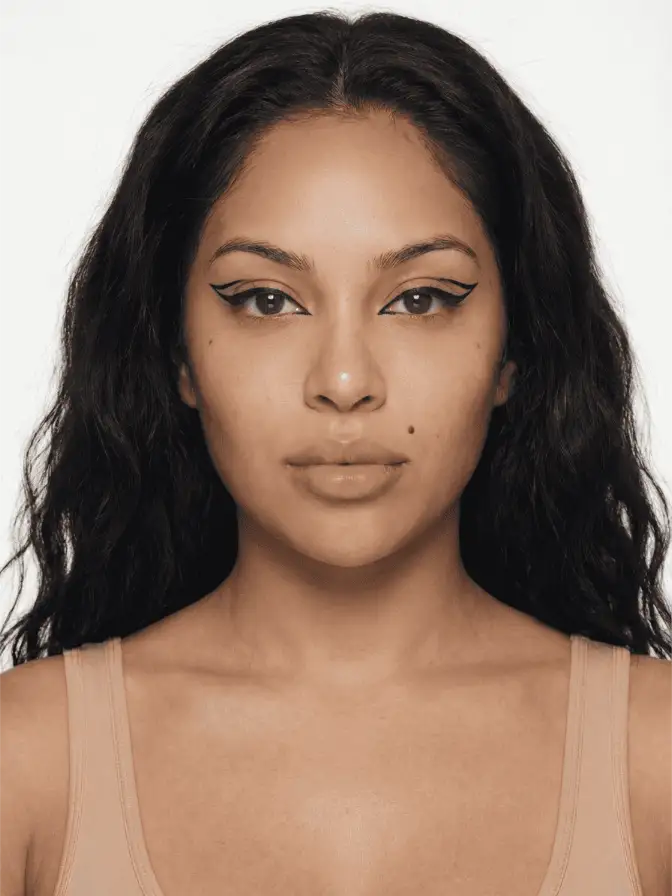
Tightlining: the inner-rim trick that thickens lashes
Tightlining packs pencil into the upper waterline so the dark base reads as lash density, not eyeliner. Here's why it changes the eye more than a wing.
Tightlining sits in a strange place in the eye-makeup hierarchy. It does almost nothing visible, in the sense that you don’t see a line. Walk away from the mirror with tightlined eyes and your friend will tell you that you look more rested, or that your lashes look longer, or that you’re wearing more mascara than usual. None of that is what you actually did.
The trick is geometry. A pencil packed into the upper waterline, the wet rim of skin behind your lash line where the lashes physically emerge from the eyelid, sits behind every individual lash. The dark line vanishes when your eye is open, hidden by the lashes themselves. What stays visible is the visual effect: the lashes now look thicker at the root because there’s no longer a gap of pale skin showing between them.
A wing, by contrast, draws a shape on top of the lid. It changes how the eye is framed, but it doesn’t pretend to be lash density. Both tools have their place. They aren’t substitutes.
Why a base under the lashes reads as fullness
Your lashes are not opaque. Look at a strong photo of an unmade eye and you can usually count perhaps thirty visible lashes per upper lid. The eye reads as fringed because of pattern recognition, not because of literal coverage. Pat McGrath and the editorial school have made entire campaigns out of exaggerating that pattern with painted lashes and clusters, but the simplest tool is the one almost no one writes about: hiding the skin between the lashes.
When the waterline behind the lashes is the same color as the lashes themselves, the eye can’t measure the gaps anymore. The fringe reads as continuous. You get the illusion of roughly double the lash density, which is wildly disproportionate to the amount of product you’ve used.
This is also why curling does so much. A curled lash brings the root closer to the lid and reduces the visible gap from below. Tightline plus a lash curl is the cheapest density hack in makeup. It’s also why some readers swear by black mascara only when they’re already brunette: the difference between curling and not curling is doing twice the work.
The pencil matters more than the brand
Almost any pencil with a creamy, smudge-proof formulation will work, but the failure points are predictable. Hard pencils drag and irritate. Pencils that haven’t been recently sharpened are too blunt to land in the waterline. Liquid liners are a bad fit; they wick into the tear film and run within minutes.
A handful of pencils get cited repeatedly by editorial artists. Charlotte Tilbury The Classic Eyeliner in Audrey is a softer waxy black that warms with body heat and packs cleanly, around £24 in the UK. Marc Jacobs Highliner Gel Eye Crayon in Blacquer has a long-wear formula that survives the waterline’s natural moisture without lifting, reformulated in 2024 to be a little less drying. Stila Smudge Stick Waterproof Eye Liner in Stingray is the budget pick at about $24, and the formula sets faster than the Charlotte Tilbury so it’s friendlier in humid climates.
The trick with any of them is to warm the tip before you start: rub the pencil against the back of your hand for five seconds so the wax softens. This is the difference between a pencil that deposits cleanly on the wet rim and one that streaks and migrates into the inner corner of the eye.
Brown reads gentler than black on most people. If you’ve ever felt like black tightlining makes your eyes look smaller, swap to a deep brown or charcoal grey for the same illusion of density with less contrast. Pat McGrath does exactly this on lighter-eyed models routinely; she has talked about brown waterline on the runway before swapping back to black for the close-up shots.
The technique itself
The hard part is staring at yourself in the mirror without blinking while a pencil approaches your wet rim. Most people give up at this point.
Tilt your chin up so you’re looking down at the mirror, then lift the upper lid with one finger by pressing gently above the lashes (not on the lid itself). The waterline is now visible. Slide the pencil tip along the wet rim using short tapping motions rather than a single dragged line. The tap deposits more product and is less likely to drift into the corner of the eye.
Three taps from inner corner outward, then a second pass to fill gaps. The whole process should take about thirty seconds. If you’re packing more than that, you’re doing too much.
A common mistake is going for the lower waterline at the same time. Resist. The lower waterline darkens the under-eye area in a way that shrinks the eye on most people. Save the lower line for an intentional grunge or sleepy look (the smokey eye builds on that, deliberately). For everyday density, only the upper goes dark.
When tightlining clashes with the rest of the face
The look reads cleanest when paired with minimal eye makeup elsewhere. A heavy crease shadow on top of a tightlined eye starts to feel like a smokey eye, which is fine if that’s the goal but not what someone goes to tightlining for. The natural pairing is a single wash of cream eyeshadow in a neutral tone, lashes curled, mascara, no liner on the lid. That combination is closer to the doe eye school than the siren eye, which is graphic by design.
Tightlining also disappears under a double wing or any heavy graphic liner. The wing covers the lash root entirely, so the dark base is redundant. Pick one or the other.
For contact lens wearers, the safety question comes up often. The American Academy of Ophthalmology’s position is that waterline application is fine with a clean, soft, kohl-free pencil and a freshly sharpened tip. The historical concern with kohl and surma pencils was lead content, not the application location. A modern pencil formulated for waterline use is a non-issue, provided you replace it every four to six months and never share one.
The two-week test
If you’ve never tightlined, the easiest way to feel the difference is to do one eye for fourteen consecutive mornings, leaving the other eye in its usual makeup state. Take a selfie on day one and day fourteen with both eyes open and a flat expression. Compare. The asymmetry on day fourteen is what the technique is doing.
Most people who run this test stop bothering with pencil on the lid entirely. The waterline does what the lid was supposed to do, and the lashes look thicker as a bonus.
Frequently asked
Does tightlining make your eyes look smaller?
Tightlining only the upper waterline makes lashes look denser without shrinking the eye. The lower waterline is what tends to close the eye visually, which is why most editorial artists keep the lower rim alone.
What pencil works best for the upper waterline?
A soft kohl pencil with a creamy, waxy formulation. Charlotte Tilbury's Audrey, Marc Jacobs Highliner in Blacquer, and Stila Smudge Stick in Stingray all pack cleanly. Liquid liners wick into the tear film and don't belong on the waterline.
Is tightlining safe for sensitive eyes or contact lens wearers?
Yes, with a clean pencil and a freshly sharpened tip. Replace the pencil every four to six months because the tip accumulates oil and bacteria. The historical concern with kohl was lead content in traditional formulations, not the application location itself.
Continue reading
- technique Stained Blush Without the Blotch: Applying Watercolor Cheek Tints Liquid and water-gel blush goes patchy because of speed and prep, not the formula. Here is the small-area, damp-finger method that fixes the blotch for good.
- technique Puppy eyeliner: the downturned wing for rounder eyes Puppy liner drops the flick instead of lifting it, the opposite of a cat eye. Why the downturned wing flatters hooded and downturned eyes, and how to draw it.
- technique Eyeshadow by Eye Color: The Complementary Rule, Used Well The color wheel says wear the opposite of your eye color. That is true and incomplete. Here is why complementary shadow works, and the nuance for each eye.