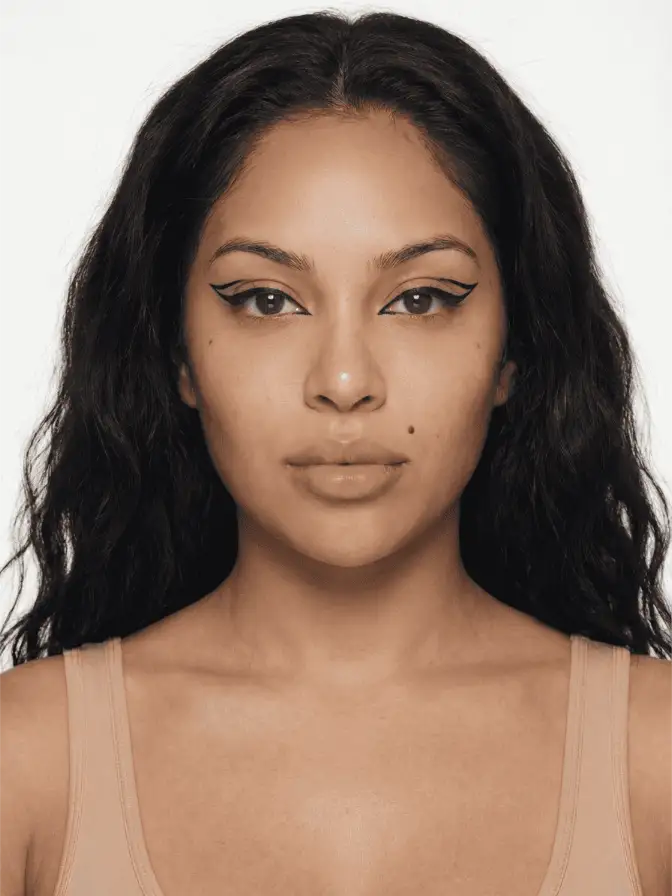
The eyeliner stamp: why pre-cut wings finally work
Eyeliner stamps were a 2014 punchline. The new generation of felt-blade tools beats freehand for symmetry, and the geometry explains exactly why.
In 2014, eyeliner stamps were sold next to Snooki perfume at CVS. The blades were stiff rubber, the ink dried into a brown smear by mid-afternoon, and the wings looked like a child had pressed a pizza cutter to your eyelid. By 2017 the category was effectively dead. Sephora pulled most of them. Vlogger reviews on YouTube reached for the word “gimmick” and didn’t let go.
The reason it has come back, with serious money behind it, is that two specific engineering problems got solved between 2022 and 2025. The first is blade geometry. The second is ink chemistry. Once you understand both, the stamp stops looking like a shortcut and starts looking like the most controlled way to put a winged liner on a human face.
The geometry of a wing your eye actually reads as symmetric
A winged liner reads as symmetric when three things match across both eyes: the angle the tail lifts from the lash line, the thickness of the tail itself, and the point at which the wing meets the upper lid. The human visual system is unforgivingly good at catching any of the three being off by more than about one degree or half a millimeter.
Freehand application, even by very skilled hands, introduces three sources of error here. The dominant-hand wing draws toward the wrist’s natural arc. The non-dominant wing fights that arc. And the brush or felt tip, held at a slightly different angle on each side, deposits a slightly different thickness. Studies of asymmetric application reviewed in Marie Claire’s contour and liner technique breakdown tend to find that artists undershoot the non-dominant wing by 8 to 12 percent in length, which is enough to look “off” in a phone photograph even if it reads fine in a hand mirror.
A stamp removes two of those three error sources. The blade is the same shape on both eyes, by definition. The angle of attack is the only variable left, and that one can be standardized with a single-dot marking step before the press.
Why the new ink chemistry matters more than the blade
The 2014 stamps used a glycerin-heavy liquid liner formula that pooled around the silicone tip. When you pressed, you got a thick ink edge and a thin center. The wing looked drawn with two parallel lines connected by haze.
The current formulas, found in the Fenty Flyliner Stamp ($24), the Stila Stay All Day Dual-Ended Liner Stamp ($25), and Lottie London’s Stamp Liner ($9 at Boots), use a quick-flash gel rheology. The ink stays viscous on the felt blade until it hits skin, then flattens evenly across the entire blade footprint. The Qogita 2026 TikTok beauty trend report singles out the winged eyeliner stamp technique as one of the year’s defining tool revivals, and the comment threads are full of users specifically noting the difference in ink flow.
If you read closely, almost every positive review mentions the same micro-detail: the wing edge holds a sharp angle for several seconds after the press, instead of bleeding outward as old stamps did. That’s the gel formula setting before it can migrate into the skin’s fine creping at the outer canthus.
How to actually use one (and when freehand is still better)
The press itself is one second. The setup is what people get wrong.
Start with a primed lid. Eye primer matters more for stamps than for brush liner because the felt blade lifts a sliver of any unset cream or powder off the lid as it comes away. A thin layer of Urban Decay Eyeshadow Primer Potion, set with translucent powder, gives the blade a stable surface to press into without lifting product.
Mark the tail position with a pencil dot, not the stamp itself. Look down into a tilted mirror with the eye open, and place a single dot where the wing tip should end. The standard rule, the tail follows the angle from the corner of the nostril through the outer corner of the eye, still applies. Skipping this step is the most common reason for asymmetric stamp wings.
Press the stamp so the back of the blade meets the dot, then rock the front edge down to the lash line. One second of contact, full pressure. Lift straight up.
Then, and this is the part that turns a stamp wing into a finished liner, draw a single thin connecting line from the inner end of the stamp to the inner lash line with whatever liquid liner you already own. The stamp gives you the geometry; the freehand stroke gives you the inner thickness control. You can read more about the principles of inner-corner liner placement in our reverse cat eye tutorial, which uses an opposing geometry but the same lash-line anchoring logic.
Stamps fail on three specific looks. Graphic liner that lifts above the crease, the kind Pat McGrath painted at Bottega for SS26, has to be freehanded because the stamp footprint sits at the lash line. Floating liner, which leaves the lash line bare, is the same problem in reverse. And any wing thicker than about 3mm reads as a chunky decal because the stamp blade was designed for a thin, sharp tail. For everything in the standard cat-eye range, which is what most people are actually doing on a Tuesday morning, the stamp wins on symmetry and time.
The TikTok demonstration effect
A piece of the revival is mechanical: the tools genuinely got better. The other piece is demonstration. TikTok’s makeup trends 2026 hub is full of side-by-side videos where users film one eye freehanded and one stamped, time the difference, and zoom in on the wing edge. The visual proof matters because the 2014 generation had given the category such a bad reputation that no amount of marketing copy was going to bring it back.
The editorial commentary at Topics That Transform’s 2016 beauty technique revival piece frames the stamp’s return as part of a broader pattern: techniques that were ahead of the tools available in their original moment getting a second life when the hardware catches up. Eyeliner stamps belong with airbrush foundation systems and magnetic lashes in that group. The idea was always sound. The execution finally arrived.
If you’ve been holding a freehand liner brush hostage to your wrist’s bad days, it’s worth the $24. Three months from now, when the muscle memory of where to place the dot becomes automatic, the whole eye look takes ninety seconds. That’s the number that’s driving the revival, not nostalgia.
Frequently asked
Are eyeliner stamps actually any good now?
The current generation is genuinely usable. The improvement is in two specific places, blade thickness and ink rheology. Older stamps shipped with a 4mm rubber tip that pooled product. Newer ones, like the Fenty Flyliner Stamp and the Stila Stay All Day Dual-Ended, use a tapered felt blade under 2mm wide that draws the wing in one even press.
Do eyeliner stamps work on hooded eyes?
Yes, but the press angle changes. Hooded eyes need the stamp held closer to vertical so the wing tip lifts above the crease shadow rather than disappearing into it. Apply with the eye open and looking down, mark the position with a dot first, then stamp.
Why does my eyeliner stamp smudge on one side?
Usually pressure asymmetry. The non-dominant hand presses harder by reflex, depositing more ink and shifting the blade as it lifts. The fix is one-second contact on both sides instead of a quick press, and a clean blot of the stamp on tissue between eyes to standardize the ink load.
Continue reading
- technique Stained Blush Without the Blotch: Applying Watercolor Cheek Tints Liquid and water-gel blush goes patchy because of speed and prep, not the formula. Here is the small-area, damp-finger method that fixes the blotch for good.
- technique Puppy eyeliner: the downturned wing for rounder eyes Puppy liner drops the flick instead of lifting it, the opposite of a cat eye. Why the downturned wing flatters hooded and downturned eyes, and how to draw it.
- technique Eyeshadow by Eye Color: The Complementary Rule, Used Well The color wheel says wear the opposite of your eye color. That is true and incomplete. Here is why complementary shadow works, and the nuance for each eye.