The Color Wash: One Shade Across Eye, Cheek, and Lip
The summer color wash puts one saturated shade on eye, cheek, and lip. Here is how to vary intensity and texture so it reads editorial, not clownish.
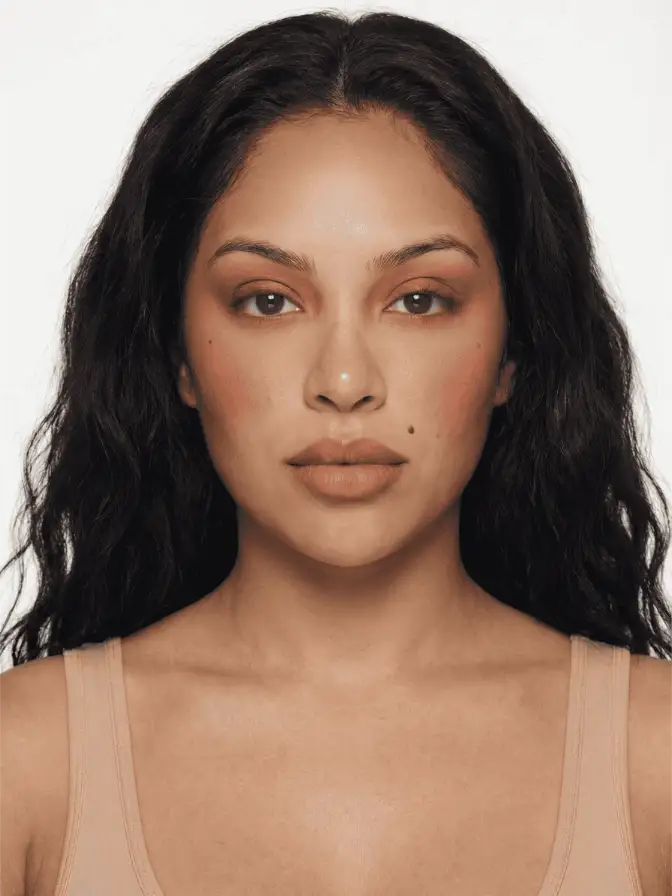
Valentino sent a model down the spring runway with deep terracotta swept from her lash line to the top of her cheekbone, the same tint blotted onto her lips. No liner, no contour, no second color anywhere on the face. Who What Wear’s summer trend report named this kind of single-shade saturation the most editorial look of the season, and the appeal is obvious once you see it move: a face built from one color reads as a decision, not a pile of products.
The technique is called a color wash, and it is harder than it looks. Put the same intensity of one bright shade on your eyes, cheeks, and mouth and you get a costume. The whole thing lives or dies on restraint.
Picking the one shade
Before any technique, the color choice decides whether this is wearable. The most forgiving shades are the ones that sit near a natural flush, because the cheek is the zone that punishes a wrong color hardest. Terracotta, soft brick, and dusty rose work across the widest range of skin tones for exactly that reason. They read as a slightly intensified version of how you look after a brisk walk.
From there, your undertone points the way. Warm and golden skin can carry peach and coral pushed up into a sunny wash. Cooler skin holds mauve and dusty plum better, which also happen to read as the more editorial end of the spectrum. Deeper skin tones get to use shades that would overwhelm someone paler, a true brick or a saturated berry, and they look richer for it. The one move that almost always works is choosing a shade one step warmer or deeper than your natural lip, close enough to look like you, intense enough to look deliberate.
Avoid anything with heavy frost or glitter for your first attempt. A color wash is about the spread of a single hue, and shimmer fights that by drawing the eye to texture instead of color.
Intensity is a gradient, not a flat coat
The single rule that separates an editorial wash from a clown face: the color gets weaker as it travels down. Your eye carries the most pigment, your cheek takes a medium flush, and your lip ends up the sheerest of the three. Ipsy’s monochrome guide puts numbers on it loosely, the eyes need the lightest physical amount of product but the most concentrated color, while the lip can hold the most product at the lowest opacity.
Think of it as one light source dropping off. The eye is where you want the eye to go first, so it earns the saturation. By the time the color reaches the lip it should look like the shade has soaked in rather than sat on top.
Beautylish’s monochromatic breakdown frames the same idea as the “rule of three,” echoing one color across all three zones so the face reads balanced. The echo is the point. Skip the cheek and the eye and lip float with nothing connecting them.
Texture does the heavy lifting
Here is the part most tutorials skip. If you wear matte terracotta on the lid, matte terracotta on the cheek, and matte terracotta on the lip, the face goes flat and the look ages instantly. The fix is contrast in finish, not in color.
Run a cream blush like Rare Beauty Soft Pinch in Happy across the cheek, a soft powder shadow in the same brick tone over the lid, and a glossy balm on the lip. Same hue, three textures, and suddenly there is dimension where a single finish would have given you a paint sample. Even when you use one shade end to end, swapping matte for cream for gloss keeps the eye traveling.
This is where a cream multi-stick earns its keep for the five-minute version. Merit Flush Balm or the Westman Atelier Baby Cheeks stick will move from cheek to lid to lip with a fingertip, and the slight unevenness of finger application reads as intentional softness. For a more finished face, build the textures separately.
Placement borrows from older techniques
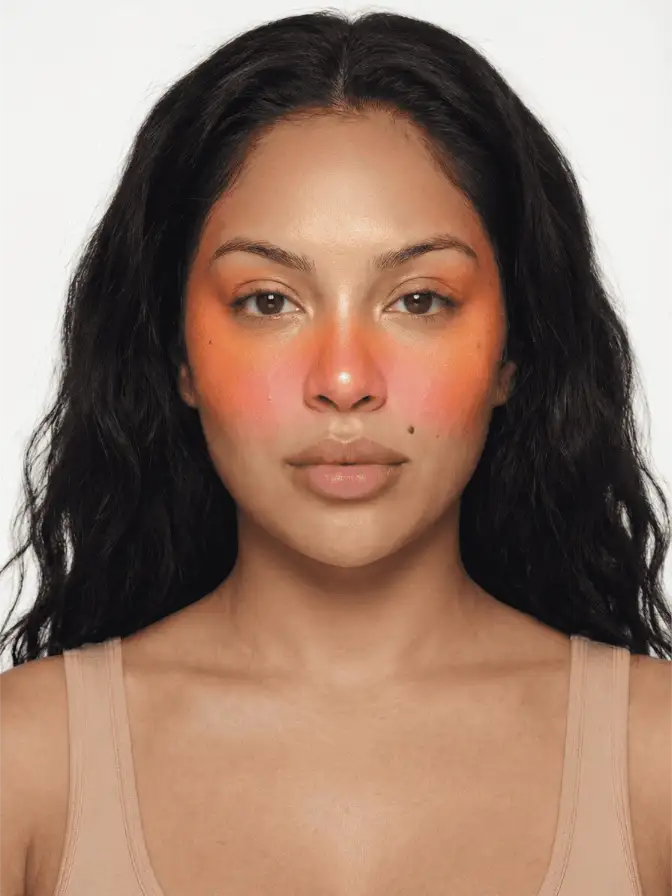
A color wash is not a brand-new idea so much as three familiar moves stacked in one tone. The cheek placement comes straight from draping, the blush-as-sculpture method where color sweeps up toward the temple instead of sitting in a round dot on the apple. Drape your wash shade and the cheek does double duty, adding flush and lifting the face at once.
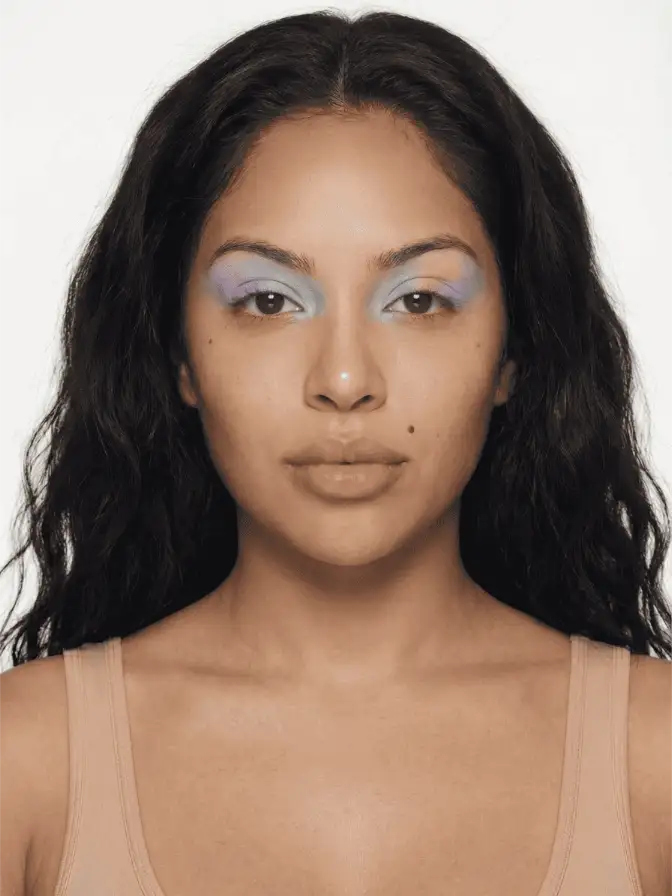
The eye borrows from a wash technique closer to watercolor eyeshadow, where pigment is diffused out past the crease with no defined edge. You are not building a cut crease. You are staining the lid and letting it fade into bare skin.
For the cleanest version, study a true monochromatic look first, then loosen it. The runway versions that landed this season were softer and less precise than the polished monochrome of a few years ago, which brings us to the lip.
The lip is a stain, not a statement
Full-opacity lipstick breaks a color wash. The mouth suddenly becomes the loudest thing on the face and the careful gradient collapses. What you want is closer to a sunset blush effect on the lip itself, color pressed in and blotted so the edges go soft and the center holds the most pigment.
Tap your wash shade onto the lip with a finger, press your lips together, and blot once on a tissue. If you started with a cream blush, it doubles as the lip tint and the color match is automatic. A clear gloss over the top adds the glassy finish the SS26 shows favored without adding a second color.
A wash you can actually wear to work
Saturated terracotta from lid to lip is a runway statement. The wearable translation keeps the structure and dials the volume down. Pick a shade one step warmer than your natural lip, dusty rose if you are fair, brick if you are deep, and treat it as a tint rather than a coat.
Cream blush drawn up the cheekbone, the same cream pressed lightly on the lid and blended out with a finger, a sheer wash on the lip, and a coat of clear mascara to keep the eyes from disappearing. That is four steps, one product if you want, and it photographs as a complete face. The wind-kissed flush that ran through the 2026 shows started here, and it survives a commute better than a full beat does.
The mistake to avoid is matching too literally. A color wash is one color family, not one exact pigment cloned across three zones. Let the cheek run a touch warmer, the lip a touch deeper, and the look breathes. Precision is what made the old monochrome feel stiff. The new version wants your hand a little loose.
Two errors that flatten the whole thing
The first is over-blending the eye until the color disappears. People get nervous about a saturated lid and buff it back so far that nothing reads from a normal distance. A wash is supposed to be visible. Build the eye until you can see the color when your eye is open and looking forward, not just when you close it.
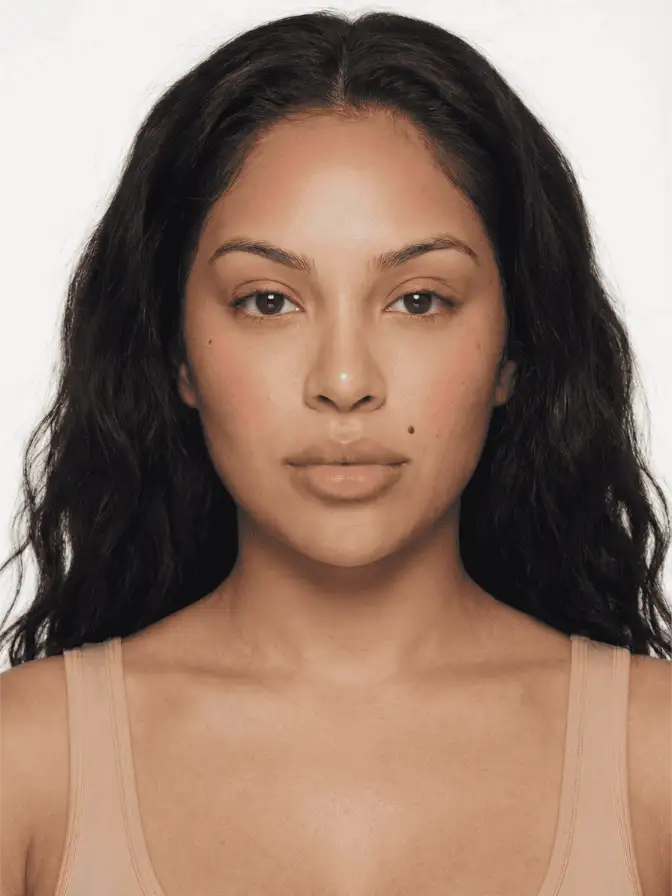
The second is forgetting the skin underneath. A color wash puts almost nothing on the rest of the face, so whatever base you wear has to carry the look on its own. This is not the technique for a heavy full-coverage foundation. A skin tint, a little concealer where you need it, and a cream you can see your own skin through will let the color sit on a believable surface. If you mask the skin first and then add the wash on top, the color floats and the whole face goes a little plastic. Keep the base light and let the one shade do the talking.
Frequently asked
How do I keep a color wash from looking clownish?
Drop the intensity as you move down the face and keep the edges soft. The eye should be the most saturated point, the cheek a medium flush, and the lip a sheer stain rather than full opacity. Diffuse every edge with a clean finger or a fluffy brush so nothing has a hard border.
Can I use the same product on my eyes, cheeks, and lips?
One cream multi-stick can do all three, and that is the fastest way in. But mixing textures looks more expensive: a cream on the cheek, a powder shadow on the lid, a glossy balm on the lip. Same color family, three finishes.
What colors work best for a monochromatic wash?
Terracotta, soft brick, and dusty rose are the most forgiving across skin tones because they sit close to a natural flush. Peach reads sunny on warm undertones; mauve and plum lean cooler and more editorial. Start one step warmer than your natural lip.
Continue reading
- technique Stained Blush Without the Blotch: Applying Watercolor Cheek Tints Liquid and water-gel blush goes patchy because of speed and prep, not the formula. Here is the small-area, damp-finger method that fixes the blotch for good.
- technique Puppy eyeliner: the downturned wing for rounder eyes Puppy liner drops the flick instead of lifting it, the opposite of a cat eye. Why the downturned wing flatters hooded and downturned eyes, and how to draw it.
- technique Eyeshadow by Eye Color: The Complementary Rule, Used Well The color wheel says wear the opposite of your eye color. That is true and incomplete. Here is why complementary shadow works, and the nuance for each eye.