Oshiroi: how geisha white makeup went from rice to titanium
Oshiroi has been worn in Japan for fourteen centuries. Tracing its formula, lead, then zinc, then titanium dioxide, ends at the molecule in your sunscreen.
The Nihon Shoki, the second-oldest book of classical Japanese history, records a strange diplomatic gift. Around the year 692, a visiting Buddhist monk named Kanjo presented the Empress Jito with a jar of lead-based white powder. She was, the chronicle says, greatly delighted. Within two generations, the same powder was a fixture on every aristocratic dressing table in Heian Japan.
That powder, oshiroi, has had a longer continuous history than almost any cosmetic still in use. The white face it produced was not a costume. It was a class signal first, then an erotic one, then an artisanal craft, and finally a tourist photograph. Along the way, the formula went through three different lead-toxicity catastrophes and ended up identical, at a molecular level, to the white film inside a tube of mineral SPF.
The Heian foundation
In the Heian period (794 to 1185), white skin was the centre of the entire aristocratic beauty grammar. Court ladies plucked their natural eyebrows, painted higher fake ones in soot and oil, blackened their teeth with iron filings (a tradition called ohaguro), and covered the whole face in a thick mineral white. The look made a courtier’s face into something close to a Noh mask, blank, immovable, unreadable except for the eyes and the lips. According to the historian Liza Dalby, who lived as a geisha in the 1970s and wrote the most-cited English account of the tradition, the goal was a kind of optical erasure: the face becomes a screen, and emotion plays across it through the smallest tilt of the head.
The chemistry came in two main forms. The Chinese-imported lead carbonate (PbCO3, called enpaku) gave the densest, most opaque finish. The competing Japanese formulation, hofun, used powdered seashell or rice. Lead was preferred for occasion makeup because of its coverage, even though by the late Heian the toxic effects were already documented. The aristocracy wore it anyway. The poor wore rice powder.
Kabuki and the second wave
The shift from court to stage came with kabuki theatre in the early 1600s. Kabuki actors needed a face that would read from the back of a five-hundred-seat hall lit only by candle reflectors. Lead-based oshiroi delivered the contrast a stage required, and the lifestyle of a kabuki onnagata (male actor playing female roles) involved wearing the powder for the better part of every working day.
The result was generations of disfigurement. Lead absorbs through skin, and chronic exposure produces facial paralysis, tremor, and the characteristic blue line at the gumline. By the late Edo period, oshiroi-related illness was so common in theatre and entertainment districts that physicians described it as an occupational disease. The records of the geisha communities in Kyoto’s Gion and Pontocho list deaths from “powder sickness” decades before lead poisoning was understood as a single condition in Western medicine.
The same exposure pattern hit the children of geisha. Maiko (apprentice geisha) often slept on wooden stands designed to preserve their elaborate hairstyles, and traces of oshiroi from a mother’s daily routine ended up on infants’ bedding. Lab Muffin Beauty Science has written about the long lag between mineral pigment use and recognised toxicity in modern cosmetics, and the pattern repeats across cultures: the formulation ages faster than the medical literature.
The 1877 zinc switch
Modern oshiroi history starts with a single Japanese cosmetics chemist, Hasegawa Toshio, who reformulated commercial oshiroi using zinc oxide in 1877. Zinc was already known in European pharmacy for its skin-soothing properties (calamine lotion is essentially a zinc-iron oxide blend). What Hasegawa proved was that zinc could match the coverage of lead at a manufacturing scale. The product launched as Goheido oshiroi and dominated the Japanese cosmetics market for the next fifty years.
Zinc was not a perfect replacement. The finish was slightly chalkier, and zinc’s density made it harder to spread evenly. The trade-off, no chronic poisoning, took a generation to become culturally non-negotiable. Lead-based oshiroi continued to be sold legally in Japan until 1934, when the Ministry of Health banned it after a series of medical reports linked use among kabuki families to congenital lead poisoning.
The 1923 import of titanium dioxide gave the industry the third pigment, and the one we now wear daily without thinking about it. Titanium dioxide is more refractive than zinc, which means a thinner layer produces the same opacity. Modern oshiroi, the kind worn by working maiko in Gion today, uses a titanium-zinc blend suspended in beeswax and oil, applied over a base of bintsuke wax. If you have ever looked at a label on a mineral foundation or a physical sunscreen, you have seen the same two oxide pigments listed.
What modern maiko actually wear
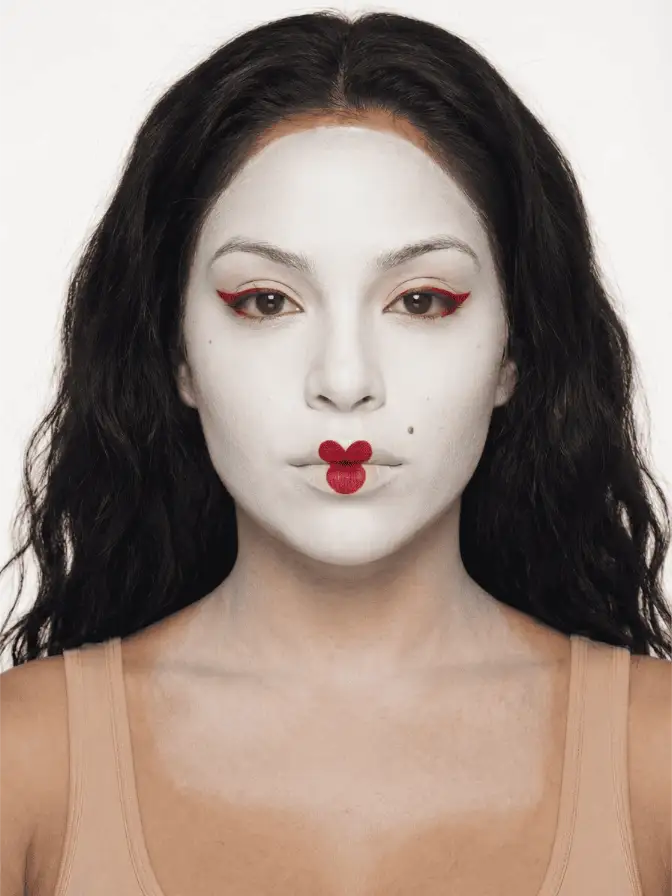
A working maiko’s makeup routine takes roughly forty minutes. The face is shaved (a tradition that began because oshiroi adheres better to skin without fine hair), then a layer of bintsuke wax is rubbed in to give the powder something to grip. The white is applied with a flat brush, then patted into the skin with a dampened sponge to set it. The classical “three forks” left unpainted at the nape of the neck reveal a triangle of natural skin and have been read by historians as both a class signal (showing the wearer is high-status enough to leave skin visible) and an erotic one. A small line of safflower-derived red pigment (beni) is painted on the lower lip alone for a junior maiko, both lips for a senior one.
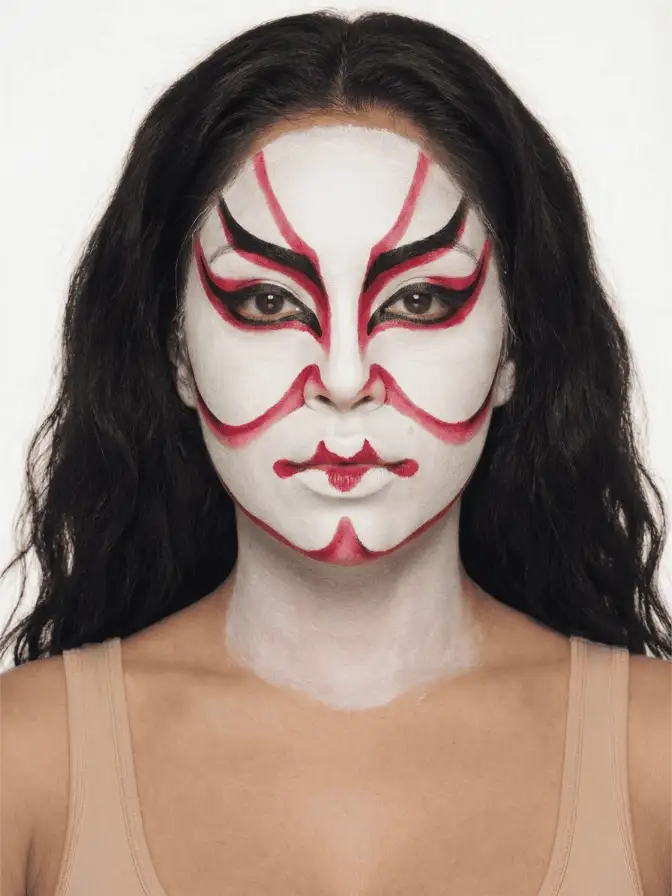
For anyone wanting to understand the actual painting technique behind the modern reproduction look, the geisha tutorial walks through the application order and the kabuki tutorial covers the heavier theatrical version with red and black accents on the temples and forehead.
The thread that ties it all together
What is striking, sitting fourteen centuries down the line, is how stable the goal has been. Heian court ladies wanted a luminous, blank canvas to make small movements legible. Edo-period kabuki actors wanted a face that read from a hundred feet away. Modern maiko want to signal a vanishing craft to clients who are paying for the experience of seeing it. And modern Western consumers, buying a tube of mineral SPF, want exactly the same titanium dioxide veil to scatter UV without any visible white cast.
The pigment moved from poison to pharmacy without ever quite leaving the dressing table. That is a reminder worth keeping when the next “miracle” cosmetic ingredient arrives: the molecule that goes into your skincare in 2026 has, almost always, already had a previous life on someone else’s face.
Continue reading
- history Egyptian Blue: The First Synthetic Pigment and the Glow It Hid Egypt manufactured a blue pigment 5,000 years ago, then the recipe vanished for a millennium. The strangest part is the glow nobody could see until 2009.
- history Cochineal: the bug that colored your red lipstick The deep red in carmine lipstick comes from a cactus insect the Aztecs taxed and Spain guarded for 250 years. How carminic acid reached your lip bullet.
- history Huadian: The Tang Dynasty Flowers Women Wore on the Forehead Huadian were the painted forehead flowers of Tang dynasty China, born from a princess and a plum blossom. The story runs from gold leaf to dragonfly wings.