Versailles rouge: the painted circle on 18th-century cheeks
How Versailles turned a dot of carmine and alum into a class signal. Louis XV's decree, the painted circle, and the lead-cinnabar history nobody mentions.
At Versailles in the 1770s, a noblewoman’s morning toilette ended with the same gesture every day. After the powder, after the rice flour and the white lead and the hair piled into a tower over wire, came the rouge. A perfect circle, the size of a small coin, dropped onto each cheek. Sometimes a streak of it dragged down toward the lower lashes. The effect was deliberate. It was supposed to look painted on.
This was not a flattering doll-blush. It was a uniform.
A decree from Louis XV
The dot of rouge on a Versailles cheek was not invented by Marie Antoinette, and it was not optional. Louis XV had decreed it earlier in the century: when his daughters came of age, they were to wear rouge in public. The custom was then extended to the foreign-born Dauphines, which meant that Marie Antoinette, fourteen years old and recently arrived from Vienna, was painted in carmine before she ever stepped into the great court.
The This is Versailles blog, which sources contemporary court accounts, frames the rouge as a layered signal at once. It indicated health, because flushed cheeks read as vitality and good circulation. It indicated modesty, in the same way a maiden’s blush did. It also, more pointedly, indicated rank. The flow of blood to the cheek was read as a reference to the blood of the nobility, the literal connection of the wearer to a higher-born lineage.
Bourgeois women who copied the look were committing a small act of class theft. Versailles ladies, depending on which faction they ran with, wore the rouge in a slightly different shape and intensity, so the savvy court eye could read the wearer’s circle at a distance.
Carmine, alum, and worse
The rouge itself was a chemical project. The University of Vermont’s 18th-century art history archive walks through what was actually in the pot. Most often the colour came from cochineal-derived carmine, which is the pigment extracted from crushed scale insects after they’re killed and dried. Boiled with alum, which acts as a mordant and locks the colour, the carmine produced a stable, deep red that could be suspended in fat, beeswax, or vinegar depending on the formula.
Carmine was the safer half of the inventory.
The same pots that left Versailles dressing tables also sold rouges based on red lead, cinnabar (a mercury-sulphide ore that grinds to a startling vermilion), and other metallic salts. The Rodama blog of 18th-century French cosmetics catalogues recipes that mixed all of these freely. Lead carbonate, the same compound used in the white face powder underneath, leached through skin and accumulated in the body. The cosmetic was a slow poison and women died of it. Marie Antoinette herself was painted in formulations that almost certainly included lead and possibly mercury.
The thing that has aged worst about this history is that nobody at the time was confused. Physicians wrote papers warning about lead in cosmetics; women bought it anyway, because the social cost of not wearing the rouge correctly was higher than the medical cost of wearing the lead version of it.
The application: dot, smear, sometimes streak
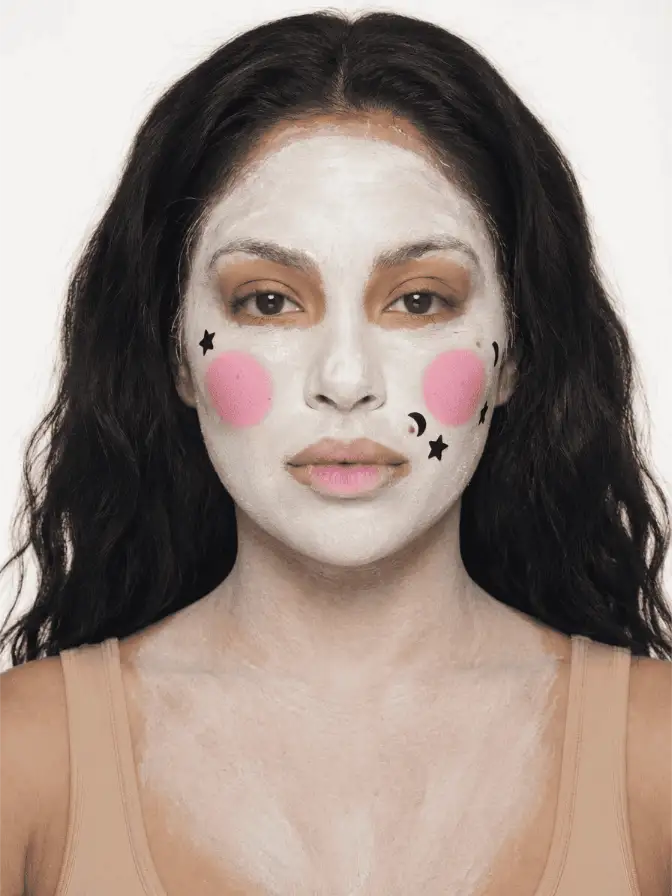
The shape of the application matters more than the colour did. As the Mental Floss reconstruction notes, court rouge was applied as “big circles of rouge on the cheeks, like the face of a china doll.” On formal court days the circles were larger, and the rouge was often dragged downward in a soft streak that reached almost to the lower lash line, which made the eye look brighter against the chalk-white face powder.
What it never was: blended. Modern blush is buffed at the edges so it dissolves into skin. Versailles rouge stopped where the woman wearing it decided it should stop. There was a hard edge. The circle read as a graphic shape from across the salon. You can see this clearly in court portraits by Élisabeth Vigée Le Brun, who painted Marie Antoinette at least thirty times. The rouge on the Queen’s face in the 1783 muslin-gown portrait sits in two near-symmetrical patches, slightly elongated under the eye, with no attempt to soften them into the surrounding white.
Get the 18th-century French rococo look from the slaye library and you’ll see the same logic translated into modern formulas: the placement is high on the apple of the cheek, the edge is intentionally graphic, the rouge sits over a luminous white-toned base rather than warm contour.
What it survived into
The Versailles court fell in 1789. The lead and cinnabar formulations went out of fashion in the early 19th century, partly because the Empire and Regency aesthetics swung sharply toward a “natural” pale face with very little visible colour, and partly because the women who could afford the worst of the formulations had been guillotined. The hard-edged circle disappeared.
It came back.
Twiggy’s 1966 painted lower lashes are a direct visual descendant. The kabuki and geisha traditions, which use a hard-edged red placed precisely on the cheekbone over a powdered white base, share more with Versailles than either tradition shares with modern Western blush. The doll-cheek aesthetic that circles back on TikTok every two years, most recently as the spring 2026 “ballerina pink” trend, is the same trick: a saturated round of colour applied without blending, placed high on the apple, kept graphic on purpose.
The current ballet-coded looks are wearing the same rouge that Marie Antoinette wore. The pigment is now mostly synthetic, the lead is gone, but the placement instinct is identical. A circle of colour on a powdered cheek reads as more deliberate than a sweep, and that deliberateness is the point.
What this history is good for
There’s a temptation, looking at Versailles, to read it as costume drama and stop there. The more useful read is that 18th-century court rouge was an early case study in makeup as a social code rather than a flattering trick. The Versailles woman was not trying to look prettier in the modern sense. She was trying to be legible to the court at fifty paces.
Modern beauty trends mostly aim at the opposite: a soft, blended, “no-makeup” finish that signals leisure and good skin. The recurring counter-pulse, blush draping, painted dolls, graphic blush, is the genre returning to the older code. Sometimes a face is meant to be read as a costume. The 18th century already had a vocabulary for that, and it’s worth knowing when something is “new” only in the sense that the people promoting it haven’t read the older citations.
The dot of carmine on the cheek of a Vienna-born teenager standing for the first time in the Hall of Mirrors was not pretty. It was a passport stamp. That’s the right context to bring back the next time a stark circle of pink lands on your feed and someone calls it new.
Continue reading
- history Egyptian Blue: The First Synthetic Pigment and the Glow It Hid Egypt manufactured a blue pigment 5,000 years ago, then the recipe vanished for a millennium. The strangest part is the glow nobody could see until 2009.
- history Cochineal: the bug that colored your red lipstick The deep red in carmine lipstick comes from a cactus insect the Aztecs taxed and Spain guarded for 250 years. How carminic acid reached your lip bullet.
- history Huadian: The Tang Dynasty Flowers Women Wore on the Forehead Huadian were the painted forehead flowers of Tang dynasty China, born from a princess and a plum blossom. The story runs from gold leaf to dragonfly wings.