Twiggy's painted bottom lashes: the 1966 mod eye, deconstructed
Twiggy wore three pairs of false lashes on top and painted every lower lash on with a brush. The 1966 mod eye, taken apart line by line.
In April 1966, the Daily Express ran a half-page photograph of a sixteen-year-old Lesley Hornby with the caption “The Face of ‘66.” The hair was Leonard Lewis’s idea, a crop he had cut on her at his Mayfair salon as a test for a model agency client and then decided he liked too much to comb out. The eyes were her own, and they have gone on outliving everything else about the era.
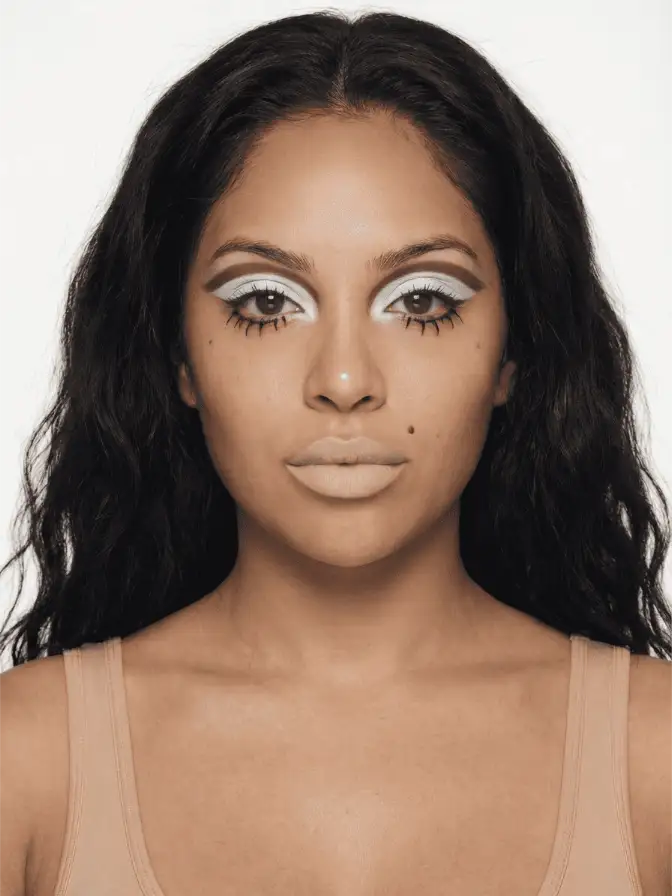
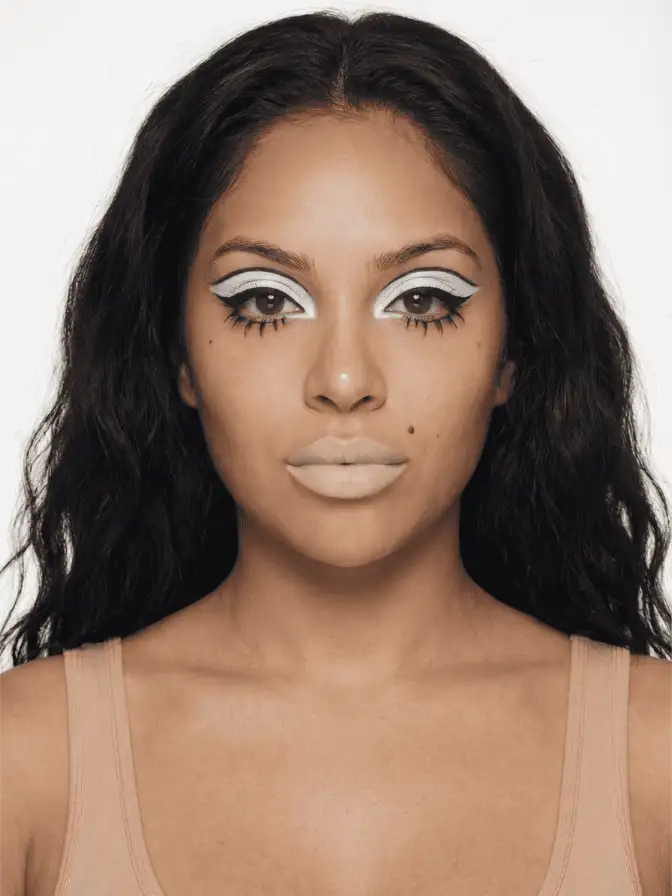
Most people know the silhouette: a deep crease shadow in dark brown, a flick at the outer corner, false lashes the length of fingernails on the upper lid, and below the eye a fan of perfectly separated lashes that read like a child had drawn them. The thing nobody seems to know, even now, is that the bottom lashes were not lashes. They were paint.
The actual technique
By Twiggy’s own account, repeated in interviews from the 1960s through her current Wikipedia entry, she wore three pairs of false lashes on her upper eyelid and painted every lower lash onto her skin with a fine brush. The Stylist piece on the trend’s modern revival breaks the geometry down: a sable liner brush, dipped in jet black eyeliner cake, used to draw individual hairs straight down from the lower lash line, each one separated from the next by roughly the width of the brush. The Bustle DIY tutorial calls out the specific shape: the painted hairs should be longer at the center and shorter toward the inner and outer corners, mimicking the way a real lash fan grows.
The Into the Gloss tutorial is more useful on the prep work. Twiggy started with white pencil along the lower waterline, then layered cream concealer underneath the lower lash line in a wide arc. The concealer brightened the under-eye area and gave the painted lashes a clean canvas. A photograph of her bare-eyed at the age of seventeen, published by Necole Bitchie in 2018, shows the original shape clearly: the natural lashes are short and pale, almost invisible, which made the painted version of them so theatrically successful.
Three pairs on top deserve their own footnote. According to interviews she gave to Vogue in 1967, the three pairs were not all the same. She wore one pair of full strip lashes for length, one pair of shorter strips overlaid for density, and a third pair of individual cluster lashes at the outer corner for the doe-eye lift. Each pair was glued in sequence with Duo, the same lash glue that had only become commercially available in the 1950s and that is still, six decades later, the default backstage adhesive.
Why the painted version mattered
The look spread fast because it was easier to fake than it appeared. Real false lashes on the lower lid, then as now, are difficult to apply, fall off in a few hours, and look obvious unless they are trimmed and individually placed. Painted lashes solved the problem in twenty minutes with a tool every teenager already owned: an eyeliner pencil. The Necole Bitchie history points out that this democratization was a real factor in the speed of the trend’s reach. The girls of the King’s Road and the suburbs of Manchester and the dorm rooms at Sarah Lawrence could all do their own version, with whatever brown or black liner they had, and the result read as Twiggy almost immediately.
The other reason the painted version mattered was the camera. Black-and-white press photography of the era ate detail at the lower lash line. Real lashes flickered and softened. Painted hairs photographed crisp because the line was uninterrupted and the contrast between black paint and pale concealer was harder than the contrast between real lashes and real skin. Look at any of the famous Justin de Villeneuve portraits of Twiggy from 1966 to 1968 and you can see the painted hairs holding their geometric integrity in a way real lashes never could.
There is also the matter of the doll-face proportion. The mod silhouette was a deliberate abstraction of a child’s face: a wide forehead, big round eyes, a small mouth. Painted lower lashes sit further down on the cheekbone than real lashes ever would, and the displacement makes the eye read larger. It was an optical trick borrowed from theatre makeup that had been doing the same thing for performers in the back rows since the Restoration.
What changed when the painted lash crossed the Atlantic
The American adoption of Twiggy’s eye in 1967 (her three Vogue covers and her American tour with Justin de Villeneuve) muted the technique slightly. American Vogue’s beauty desk under Diana Vreeland recommended a softer approach: a brown rather than a true black liner for the painted lashes, and only a single pair of false lashes on the upper lid, supplemented by extra mascara coats. The American mod eye was prettier, smaller in scale, and easier on a Manhattan office worker’s commute.
It was also less Twiggy. The original look had been theatrical by design. The Daily Express photograph that started it all was lit hard with a single flash, and the eye makeup was scaled for that lighting. Soft-pedaled, it lost the cartoon punch that had been the entire point.
How the look comes back
Eye makeup trends move on a roughly fifteen-year cycle. Twiggy’s painted lashes have come back in earnest at least four times since 1966: in the punk-inflected 1981 New Romantic moment, in the heroin-chic 1995 revival around Kate Moss’s first Calvin Klein campaign, in the indie-sleaze 2007 wave, and now again in 2025 to 2026 with TikTok creators reviving the technique under the umbrella of “doll lashes” and “Twiggy doll eye.”
The 2026 version is closer to the original than any of the previous revivals. Liquid liner with a tiny brush has replaced the cake-and-sable-brush method of the 1960s, but the principle is identical: painted hairs, perfectly separated, in a fan shape that sits below the natural lash line. Stylist’s recent piece on the resurgence calls out the specific brushes most often used now (the Bobbi Brown Ultra Fine Eye Liner Brush, the MAC 209) and the most-referenced product (Stila Stay All Day Waterproof Liner) for this exact application.
What does not come back, and probably never will, is the three-pair upper lid. The maximalism of late-1960s eye makeup belonged to a specific cultural moment that wanted its faces to look drawn rather than dewy. The painted lower lash, though, survives every trend turnover. It is too good a trick. A pencil, a steady hand, and the same optical illusion that was true in 1966 still works in 2026.
Continue reading
- history Egyptian Blue: The First Synthetic Pigment and the Glow It Hid Egypt manufactured a blue pigment 5,000 years ago, then the recipe vanished for a millennium. The strangest part is the glow nobody could see until 2009.
- history Cochineal: the bug that colored your red lipstick The deep red in carmine lipstick comes from a cactus insect the Aztecs taxed and Spain guarded for 250 years. How carminic acid reached your lip bullet.
- history Huadian: The Tang Dynasty Flowers Women Wore on the Forehead Huadian were the painted forehead flowers of Tang dynasty China, born from a princess and a plum blossom. The story runs from gold leaf to dragonfly wings.