Lace makeup: applying lace stencils without the craft-store look
Pinterest's lace makeup trend can read as couture or as Halloween, and the difference comes down to lace weight, pigment contrast, and where you place it on the face.
The Pinterest Predicts 2026 report tracked a 215 percent rise in searches for “lace nails” and a 120 percent rise for “lace makeup” heading into the year, with related queries like “avant-garde makeup” climbing 270 percent. The numbers explain why every fashion week beauty room from February onward had at least one artist stenciling lace onto a model’s cheekbone. What the numbers don’t explain is why most of the lace makeup on TikTok looks beautiful and most of the lace makeup that ends up at parties looks like a craft-store accident.
The difference is mechanical, not artistic. Three variables decide whether a lace stencil reads as couture detail or as Halloween: the lace itself, the pigment contrast against your skin, and how much of your face you cover.
The lace fabric matters more than the technique
Most tutorials skip past the choice of lace, which is the actual hinge of the look. Pat McGrath’s SS26 runway lace, photographed at the Maison Margiela couture show in January, was a fine chantilly with floral motifs roughly half a centimeter across. Isamaya Ffrench’s Burberry Beauty stencil work uses similar weight, sometimes guipure with a slightly denser thread.
Stiff polyester crochet trim, the kind sold by the spool at craft stores for two dollars, has thread that’s around three times thicker than bridal chantilly. When you press pigment through it, the pattern stamps as solid blocks. The result reads as a stencil. The reason bridal chantilly works is that the thread is fine enough that the pattern reads as a tonal shadow on skin, not as a printed shape.
Buy a quarter yard of cotton chantilly or fine floral guipure from a bridal fabric supplier. A piece roughly four inches square is enough for cheekbone and temple work, and the same piece lasts dozens of applications if you rinse it between uses.
Pigment contrast is what decides “soft” versus “stamped”
The TikTok version of lace makeup that goes most viral, especially on creators like Nikkie de Jager who walked through the technique in autumn 2025, picks a pigment within roughly two shades of the wearer’s skin. Soft taupe on fair skin. Muted bronze on medium. Warm cocoa on deep complexions. The lace reads as a tonal texture rather than a graphic statement.
The editorial version pushes contrast harder. Black lace patterned in liquid liner across the temple, the way McGrath did it on Mona Tougaard for Margiela couture, photographs beautifully because runway lighting flattens contrast. The same look in soft daylight reads as cosplay.
There’s a useful middle option that none of the viral tutorials seem to discuss. Pressing a soft burgundy or russet through fine lace, slightly cooler than your blush, gives the depth of an editorial look while staying inside the spectrum of normal cheek color. It feels like wearing a heavier blush, not a costume.
Placement: a patch, not a mask
The lace-face videos that circulate most often, where someone glues the lace across the entire face and applies foundation through it, are designed for the algorithm. They create the strongest before-and-after pull. They are also why most people who try lace makeup at home stop trying after one attempt.
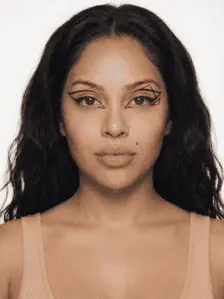
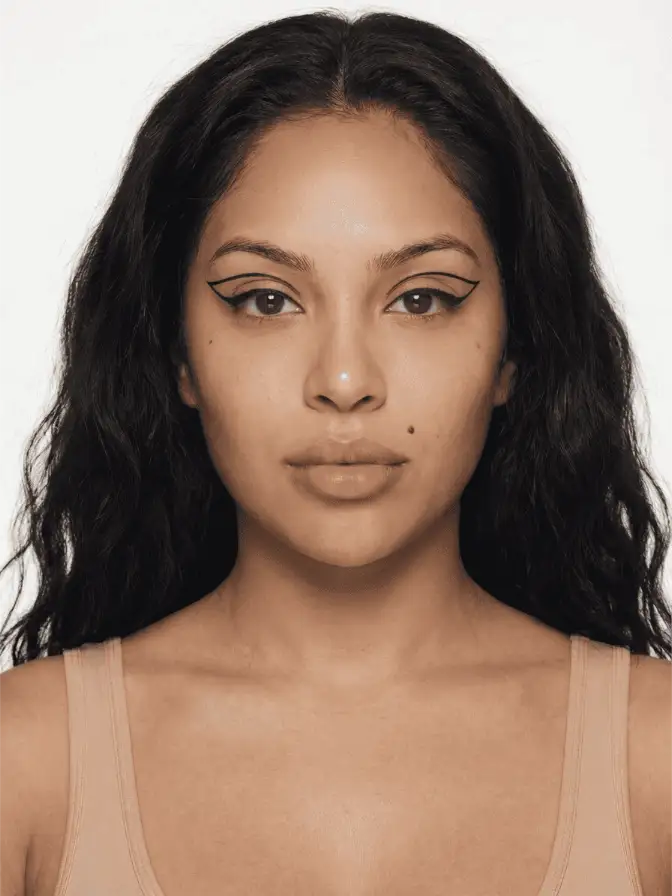
A single placement is enough. A four-inch stencil on the cheekbone, sitting between the apple of the cheek and the temple, gives the effect of intricate detail without committing to a mask. A narrow arc above the brow bone, mirrored on both sides, reads as a quiet decorative flourish. The cheekbone placement pairs naturally with graphic eyeliner because the eye becomes the visual anchor and the lace becomes the surrounding texture. Lace at the brow bone pairs better with a negative space liner look that leaves the eye relatively open.
For evening, lace plus a glossy cream cheek (in a tone that picks up the lace pigment) is the most workable combination. The shine catches light and softens the geometry of the pattern. A flat matte cheek tends to flatten the lace too.
The application sequence that actually works
Most lace tutorials describe gluing the lace to the face, which is unnecessary and tends to either lift skin or leave residue. Hold the lace in place with mild tension instead, pinch a corner with your non-dominant hand and rest the rest of the fabric flat against the cheek.
Start with finished base makeup. Lace works on a complete face, not a bare one, because the pattern reads against the surrounding even-tone skin.
For powder products, load a small flat brush, tap off the excess until the brush is nearly dry, and press straight down through the lace in firm stippling motions. Do not sweep. Sweeping shifts the lace and smears the pattern.
For cream products, use a small fingertip or a flat synthetic brush, again pressing straight down. Cream gives a sharper edge but takes more practice because shifting the lace during pickup smudges the pattern.
Lift the lace straight up off the skin in one motion. Pulling it sideways drags pigment and ruins the edges.
A reference video that’s useful for the lift technique, posted by Sammy Robinson during Australian Fashion Week 2025, slows down the moment of removal and shows how a clean lift preserves the entire pattern.
Why this trend has staying power past one season
Lace makeup overlaps with three Pinterest 2026 categories that aren’t usually grouped together: the rise in “tactile beauty” (a related search term, “jelly blush”, climbed 130 percent), the dark-romantic surge (where “vampire beauty” rose 90 percent), and the balletcore revival that’s pulling soft femininity back into fashion week beauty.
It also benefits from being expensive-looking but cheap to execute. The Pat McGrath SS26 lace, by the artist’s own account in an Allure backstage note, was sourced from a Paris notions shop for under twenty euros. The Mac Studio Fix powder she pressed through it costs thirty-eight dollars and would last a year of daily wear. The technique scales down to a normal beauty budget without losing the effect.
Whether lace makeup is still a real trend in 2027 depends mostly on whether artists keep finding new placements. Lace at the décolletage, lace along the orbital bone, lace on the lip (a variation where liquid lipstick is pressed through and the lace is lifted as a stencil) all extend the runway. If they catch, the search numbers will keep climbing. If the look gets stuck at “lace face mask”, it’ll burn out the way most TikTok stencils do.
For now, a single tonal patch on one cheekbone is the safest entry point, and the one most likely to draw a quiet compliment rather than a costume question.
Frequently asked
What kind of lace works best for lace makeup?
Fine chantilly or floral guipure with at least 30 percent open space. Stiff polyester crochet trim from craft stores reads as costume because the lines are too thick and uniform. Buy a quarter yard of bridal-trim chantilly from a fabric shop instead, cut a piece around four inches square, and you can re-use it for a dozen looks.
Will lace makeup come off your skin easily?
Yes, when you build it with cream products. Cream eyeshadow, blush, or a stick highlighter wipes off with the same micellar water you use for the rest of your face. Powder pressed through lace lifts off with cleansing balm. The only stubborn version is using a long-wear liquid liner, which can take two passes.
Can you wear lace makeup outside of a costume context?
If you keep it to one placement (a single cheekbone stencil or a brow-bone arc) and stay within two shades of your skin tone, yes. The full-face lace mask reads as styled editorial. A four-inch tonal patch on a cheekbone reads as a finished beauty look that someone will quietly compliment.
Continue reading
- trends The Gray Grunge Eye: The Soft Rock-Star Smudge of Summer Black smoke went hard and dated. The gray grunge eye on this summer's runways is smudged, dewy, and cool. Here is why it works and how to wear it.
- trends Butter Yellow Eyeshadow, the Soft Neutral That Isn't Butter yellow ran the runways, then landed in TikTok makeup tutorials. It acts like a warm neutral but reads as color. Here is how to wear it by skin tone.
- trends Sunburn Blush: The Flush That Crosses the Nose The summer 2026 blush trend drags warm color across the nose and upper cheeks to fake a sun-touched flush. Here is where to place it and what holds in heat.