Kabuki Kumadori: The Painted Language of the Stage
Every red and blue line in kabuki's kumadori makeup encodes a character's morality. Here is the centuries-old color code, and the actor who began it.
Picture a theatre in 1670s Edo with no stage lighting to speak of, an audience packed to the back wall, and an actor who needs every one of them to know, on sight, that he is the hero. He cannot rely on his face. The face is too far away and too dim. So he paints a language onto it.
That language is kumadori, and it is still spoken on the kabuki stage today.
The word tells you the method
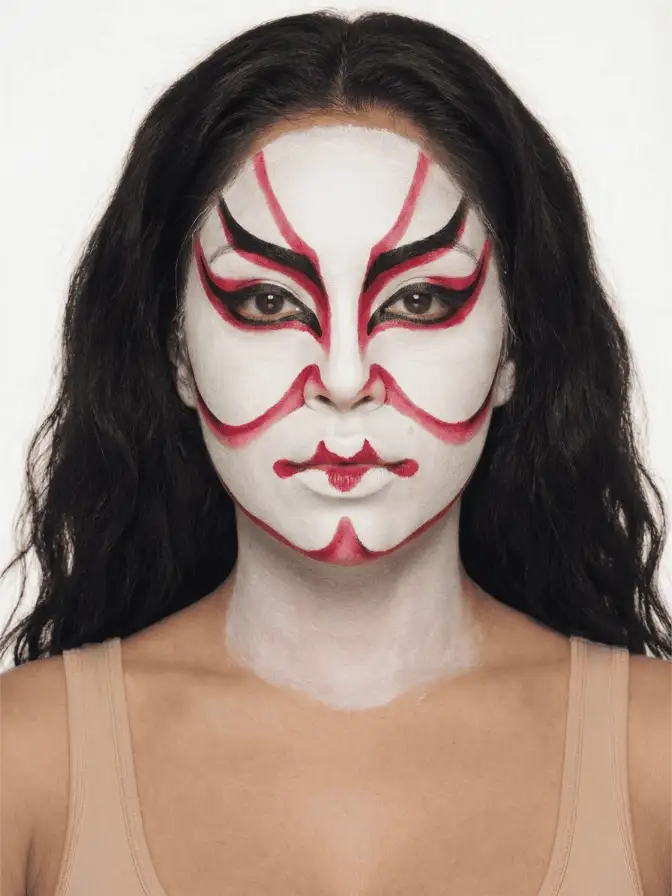
Kumadori translates as something close to “shade-taking,” and the name is a working description, not a poetic flourish. The technique starts with a white base, usually a rice-powder or oil-based foundation laid thick, and then bold colored lines are drawn over it and blended outward at the edges. According to the National Theatre’s own teaching materials, those lines are meant to trace the muscles and veins of the face, pushing a human expression into something monumental and legible from a distance.
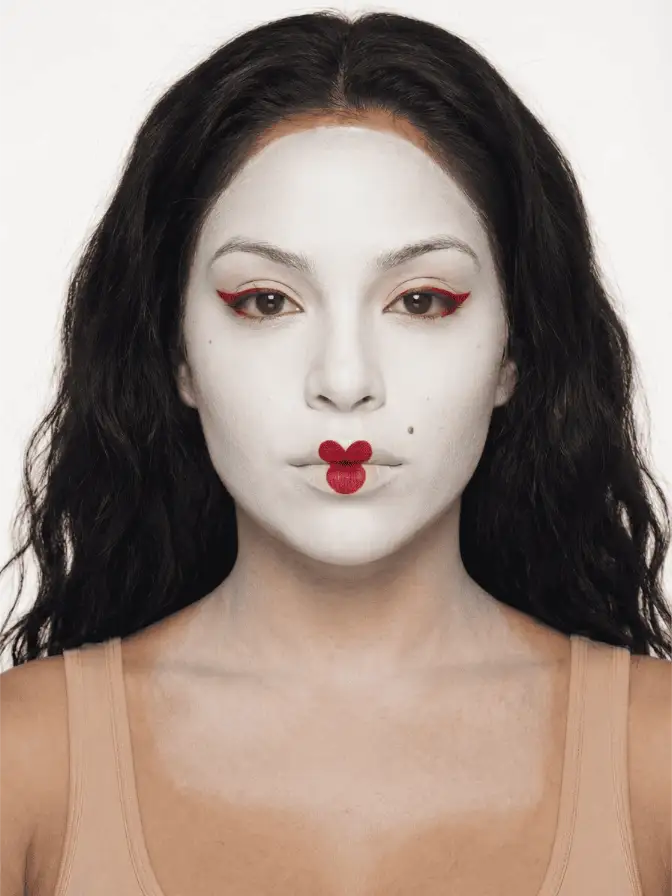
The white base is the canvas the rest depends on. It flattens the actor’s natural features into a blank, bright field so the colored lines read with maximum contrast. There is a kinship here with the white-foundation tradition you can see in geisha makeup, though the two serve different ends; the geisha’s white is about refined stillness, while the kabuki actor’s white exists to be violently overdrawn.
One actor, one year
Kumadori has a startlingly precise origin story. The style is credited to Ichikawa Danjuro I, who in 1673 introduced bold red and black patterns to play a superhuman warrior hero. Before that, kabuki leaned closer to the restraint of older forms like Noh. Danjuro’s innovation was to throw restraint out, to make the makeup as oversized as the heroics, and it stuck. The Ichikawa line carried the style forward as a kind of family signature, and the broader tradition fanned out from there into the roughly hundred distinct mask-like patterns recorded over the centuries.
What makes that 1673 date worth holding onto is how rare it is to be able to point at a single person and a single year for the birth of a makeup convention. Most cosmetic history is a slow drift with no author. Kumadori has a name attached.
Reading the colors
The genius of the system is that the colors are not decorative. They are information, and Edo audiences learned to read them the way we read a stoplight.
Red kumadori marks virtue. Encyclopedia.com and the National Theatre’s guides agree on the core vocabulary: red lines signal justice, courage, and strength, the palette of the hero. When you see a face crossed with bold crimson sweeps, you are looking at the character you are meant to root for.
Blue, or a cold indigo, is the inversion. It signals villainy, jealousy, and the chill of the supernatural. The antagonist wears blue. A vengeful ghost wears blue. The audience does not need a single line of dialogue to know the temperature of the character standing in front of them.
A third register handles everything outside the human moral scale. Brown tends to mark oni, the demons, and other yokai, the monsters and spirits that are neither hero nor villain but something stranger. The line patterns themselves carry meaning on top of the color, with sharper, angrier strokes reading as rage and softer ones as nobility.
Patterns with names
The roughly hundred recorded kumadori designs are not improvised. They are named, codified styles, each tied to a kind of character, and a few are worth knowing because they show how specific the language gets.
Sujiguma, the “striped” pattern, uses bold, separated red lines and belongs to a hero at the peak of rage or power, the kind of role that anchors the famous play Shibaraku. Mukimiguma is gentler, a softer red used for a handsome, righteous young man, the romantic lead rather than the warrior. Aiguma, built on indigo rather than red, is the face of the villain or the vengeful spirit, the cold counterpart to the hero’s warmth. The actor and the role together dictate which pattern goes on; you do not choose kumadori by taste, you choose it by character.
The application is its own discipline. The white base goes on first and must be flawless, because every colored line is then drawn and immediately blended outward with a finger or a soft brush so the edge fades into the white, mimicking the swell of muscle and the rise of a vein. That blended gradient is the “shade” the name promises. Done well, it gives a flat painted face the illusion of three-dimensional fury or nobility under stage light.
The face you can keep
One tradition turns the makeup into an object. After a performance, an actor can press a piece of silk or paper directly onto his painted face, lifting a mirror-image print of the kumadori. The print is called an oshiguma. The actor often signs it, and these impressions are collected and treasured, sometimes given to patrons or sold for charity. It is a startling idea when you sit with it: the makeup is so much the art that a single wearing of it can be preserved, framed, and hung like a print pulled from a plate. There is no real Western cosmetic equivalent. We wash our looks off. A kabuki actor can keep his.
That practice tells you everything about how the tradition regards the painted face. It is not adornment that vanishes at the end of the night. It is a work that can outlive the performance.
Why the system survives
It would have been easy for kumadori to fossilize into a museum curiosity. It has not, and the reason is that it solved a real problem so well that the solution outlived the problem. The original need was practical: dim theatres, distant audiences, a story that had to land instantly. Modern kabuki stages have lighting now. The makeup stayed anyway, because by then it had become the art itself rather than a workaround.
There is something worth sitting with there for anyone who loves makeup as a medium. Kumadori is one of the few places where face paint is unambiguously a written language, where a red line is not “pretty” but a declared statement about a person’s soul. Most of what we do with pigment is suggestion. This is closer to text. If you want to see the structure of it up close, the modern kabuki look keeps the grammar intact: white field, bold color, lines that follow the muscle and tell you, before the actor moves, exactly who he is.
Frequently asked
What do the colors in kabuki makeup mean?
Red lines signal a virtuous character: justice, courage, strength, the hero. Blue or indigo lines signal the opposite: villainy, jealousy, the supernatural menace of a ghost or antagonist. Brown tends to mark non-human creatures like demons and monsters.
What does kumadori mean?
It translates roughly as 'shade-taking' or 'taking the shadows.' The name refers to the way the colored lines are drawn and then blended outward to suggest the muscles and veins beneath the skin, exaggerating the face into something readable from the back row.
Continue reading
- history Egyptian Blue: The First Synthetic Pigment and the Glow It Hid Egypt manufactured a blue pigment 5,000 years ago, then the recipe vanished for a millennium. The strangest part is the glow nobody could see until 2009.
- history Cochineal: the bug that colored your red lipstick The deep red in carmine lipstick comes from a cactus insect the Aztecs taxed and Spain guarded for 250 years. How carminic acid reached your lip bullet.
- history Huadian: The Tang Dynasty Flowers Women Wore on the Forehead Huadian were the painted forehead flowers of Tang dynasty China, born from a princess and a plum blossom. The story runs from gold leaf to dragonfly wings.