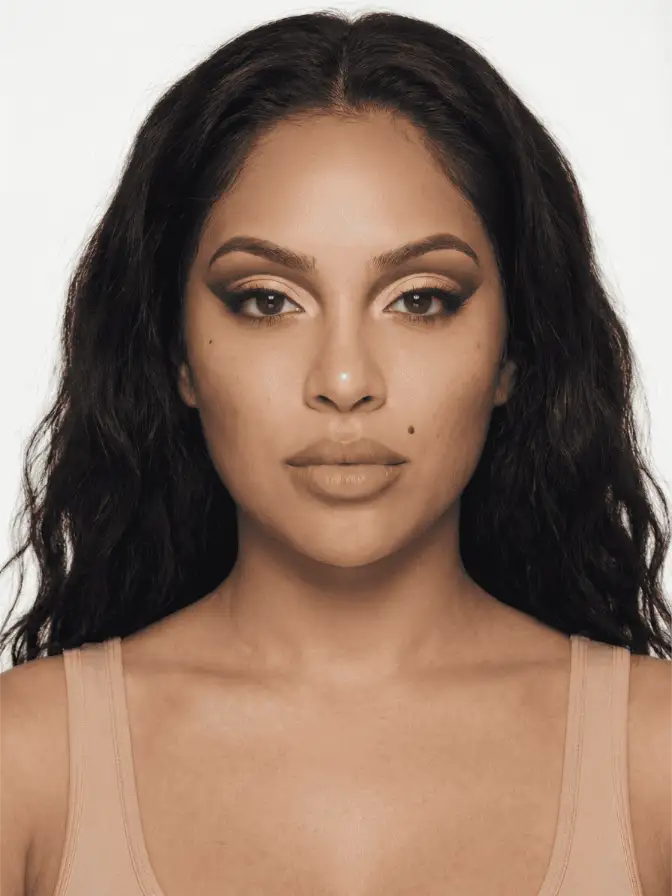
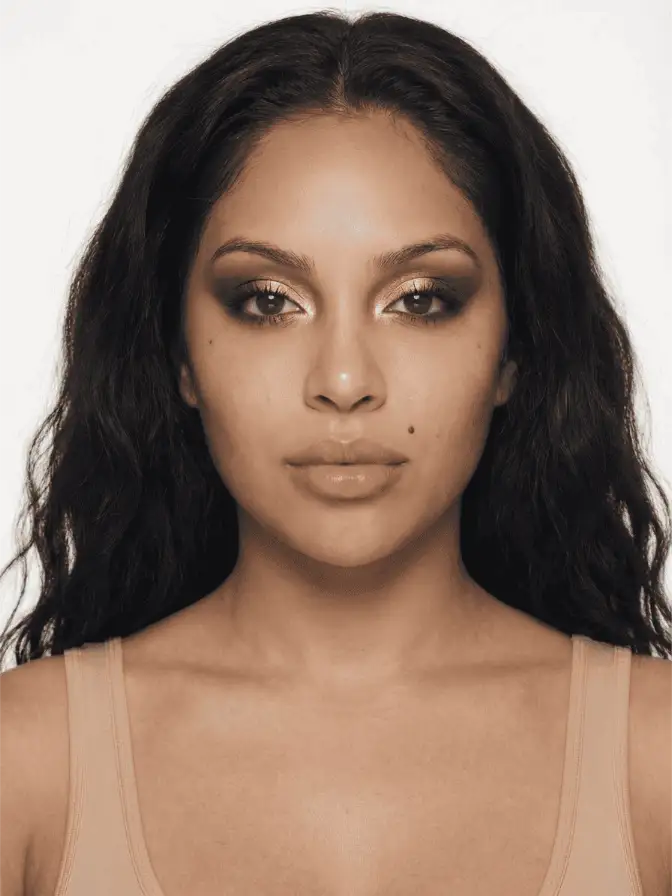
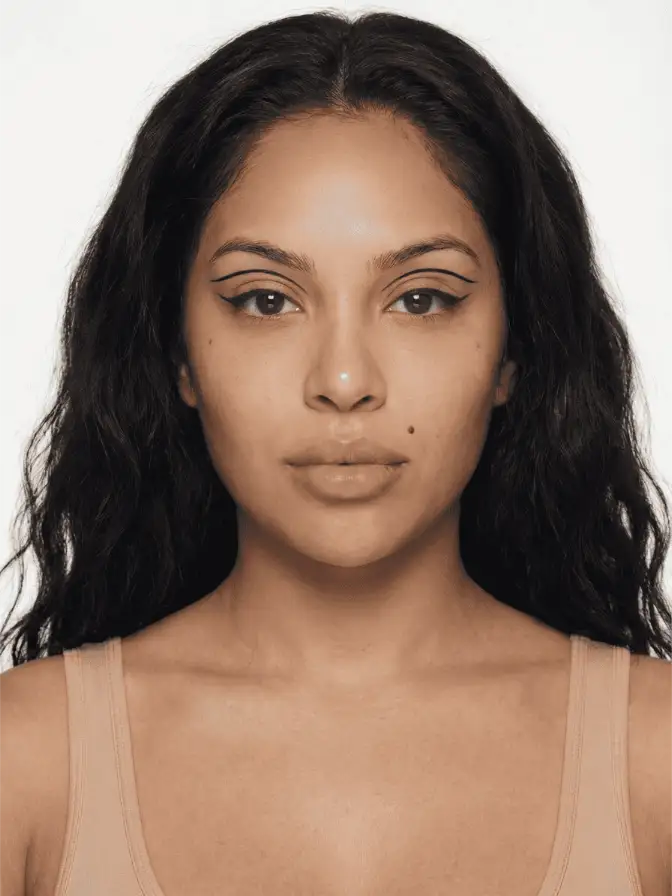
Hooded Eyes: The Open-Eye Mapping Rule That Fixes Everything
Why eyeshadow vanishes on hooded eyes the moment you blink, and the open-eye mapping method that builds a crease where your fold can't swallow it.
Roughly half of all eyes have some degree of hooding, by most makeup artists’ working estimates, yet nearly every eyeshadow diagram you have ever seen was drawn for one eye shape: the deep-set lid with a visible crease. Lid color, crease shade in the fold, highlight under the brow. Follow that map on a hooded eye and the whole design vanishes the second you look up from the mirror.
The problem isn’t your blending. It’s that you mapped the eye while it was closed.
The mistake is in the mirror, not the brush
Here’s what actually happens. You close one eye, sweep a warm matte like MAC Wedge through what you can feel as your crease, blend it out, and it looks great. Then you open your eye. The skin under your brow bone settles forward over the mobile lid, the fold swallows everything below it, and you’re left with a bare lid and a faint shadow line hiding somewhere you can’t see.
Patrick Ta’s team puts it plainly in their hooded-eye guide: color has to sit above the natural crease, because the crease collapses over it the moment the eye relaxes. Finnish beauty writer Charlotta Eve built an entire method around the same insight years ago, and it has been quietly circulating in hooded-eye communities ever since. She calls it placing the contour shade where the natural shadow falls below the brow bone, not where the anatomical crease sits.
The rule that follows from this is short enough to memorize.
Map everything with your eyes open, looking straight ahead.
If you can’t see a color while looking directly at the mirror, it doesn’t exist. That’s the whole rule, and it changes every placement decision downstream.
Building the fake crease
With eyes open, find the spot where you want a crease to appear. On most hooded eyes this lands two to four millimeters above the true fold, on the lower slope of the brow bone. That feels alarmingly high the first time. Trust the open-eye check, not your instinct.
Take a soft matte one or two shades deeper than your skin tone. Something with slip and low pigment load works better than a dense shade here; Makeup by Mario’s Master Mattes palette was practically engineered for this kind of sheer, buildable crease work. Draw a faint arc at your chosen height with eyes open, checking after each pass. Then close the eye briefly, blend the edges, open, and reassess. Open-eye checks between every step.
What you’re doing is painting a shadow where a crease would be if the hood didn’t cover it. The technique borrows directly from the cut crease, which carves an artificial line above the fold, and from the floating crease, which draws the crease as a graphic element with no blending at all. The hooded-eye version sits between the two: raised like a cut crease, soft like traditional shading.
One warning from the Allure Philippines team’s guide, and it’s a good one: keep shimmer out of the fold zone. Reflective particles in the crease bounce light off exactly the area you’re trying to recess, which makes the hood look puffier. Mattes carve; shimmers advance.
Where the shine goes instead
Shimmer still belongs on a hooded eye. It just lives in two places: the center of the mobile lid and the inner corner.
A finger-pressed satin in the middle of the lid catches light when you blink and talk, which is when hooded lids are most visible to other people anyway. Cream formulas survive the skin-on-skin contact of a hood far better than powders; a long-wear shadow stick in champagne or rose gold, set firmly, will outlast almost any baked shimmer. The halo eye is built on exactly this logic, darkness at both ends and light in the center, and it’s one of the most flattering structures for hooded shapes for that reason.
The inner corner dot is small but does real work. It pulls the visual weight of the eye inward and up, away from the outer hood, which is usually where the fold sits heaviest.
Liner gets the same open-eye treatment. A classic thick wing transfers onto the hood within an hour. Go thin, tightline the upper waterline for density, and if you want a flick, draw it with your eyes open so it angles up toward the tail of your brow, skipping over the fold rather than disappearing into it. A diffused pencil smudged at the roots, the soft structure underneath any good smokey eye, is more forgiving than liquid on hooded shapes.
The five-minute version
Not every morning needs architecture. The compressed routine: one matte arc above the fold mapped with eyes open, one cream shimmer pressed on the center lid, tightline, curl, two coats of a tubing mascara that won’t transfer onto the hood. Vogue Adria’s hooded-eye principles piece makes the case that lash curl alone does more lifting than most shadow work, and on low-effort days that’s the one step not to skip. A strong curl physically raises the lash canopy off the hood.
Waterproof or tubing mascara matters more here than for other eye shapes. The hood rests on the lashes all day; a soft formula will print a gray stamp above your crease by noon.
Making it survive the fold
Placement solves visibility. Wear is the second battle, because a hooded lid is skin resting on skin for sixteen hours, and that contact grinds powder into the fold and migrates cream onto the hood.
Primer is not optional here. An actual eye primer with film-forming polymers, Urban Decay Primer Potion or NARS Smudge Proof are the long-standing references, grips pigment in a way concealer never will. Concealer as a base is the most common substitute and the worst one for this eye shape: it stays emollient all day, and emollient plus friction equals a creased stripe in the fold by mid-morning. Prime, set the primer with a skin-tone matte pressed in with a flat brush, and then build color on top of that dry, gripping surface.
For the fake crease itself, a long-wear cream stick under the powder arc doubles its lifespan. Draw the arc with something like a Laura Mercier Caviar Stick in a neutral brown, blur it with a fingertip, let it set for thirty seconds, then mirror the same shape in powder over it. The cream bonds to the primer, the powder bonds to the cream, and the structure stops moving.
And check your work the way it will actually be seen. Step back from the mirror a full arm’s length, look straight ahead, then glance slightly down the way someone taller sees you on the street. Those two angles are the entire audience of an eye look. The close-up, eyes-shut view you blended in is one nobody else will ever see.
Hooded eyes aren’t a flaw to correct. Some of the most photographed eyes in the world are hooded, and the shape gives a low-lidded, unbothered quality that deep-set eyes spend effort trying to fake. The makeup just follows different geography. Map it open-eyed, build the crease where the light can reach it, and the design finally stays where you put it.
Frequently asked
Why does my eyeshadow disappear when I open my eyes?
On a hooded eye, the brow bone's fold of skin rests over the mobile lid when your eyes are open. Any color placed only on the lid gets physically covered. The fix is placement, not product: map your shadow with eyes open and build definition above the natural fold so it stays visible at rest.
Should hooded eyes avoid shimmer eyeshadow?
No, but placement matters. Shimmer in the fold catches light and makes the hood read heavier. Keep shimmer on the center of the mobile lid and the inner corner, where it brightens, and keep mattes in and above the fold zone.
Where do I put eyeliner on hooded eyes?
Thin and tight to the lash line. A thick wing folds onto itself when the hood drops. Tightlining the upper waterline gives lash density with zero lid real estate, and a small flick angled toward the tail of the brow stays clear of the fold.
Continue reading
- technique Stained Blush Without the Blotch: Applying Watercolor Cheek Tints Liquid and water-gel blush goes patchy because of speed and prep, not the formula. Here is the small-area, damp-finger method that fixes the blotch for good.
- technique Puppy eyeliner: the downturned wing for rounder eyes Puppy liner drops the flick instead of lifting it, the opposite of a cat eye. Why the downturned wing flatters hooded and downturned eyes, and how to draw it.
- technique Eyeshadow by Eye Color: The Complementary Rule, Used Well The color wheel says wear the opposite of your eye color. That is true and incomplete. Here is why complementary shadow works, and the nuance for each eye.