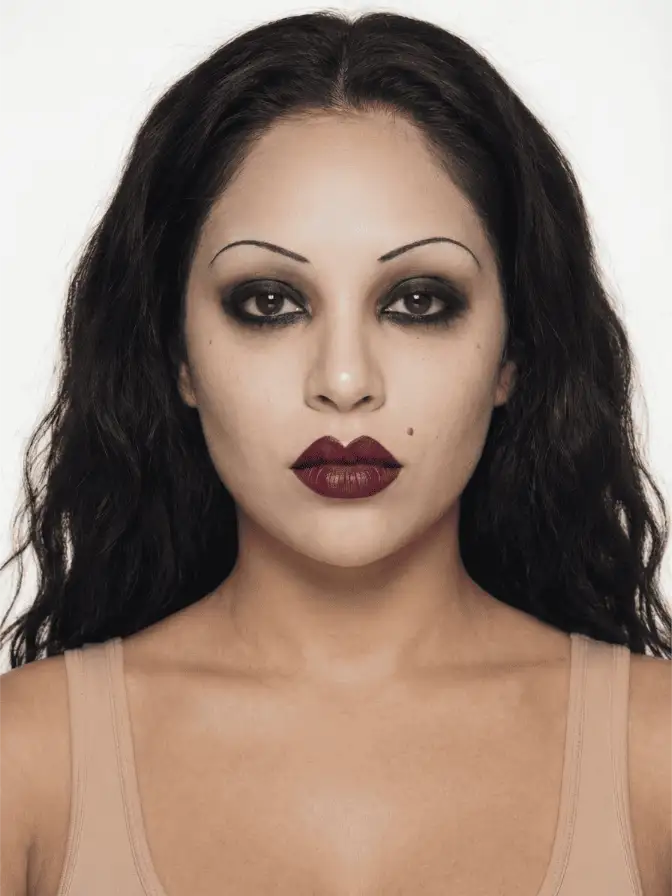
Theda Bara and the Vamp Eye That Built a Villain
Before the flapper, a 1910s silent-film star turned kohl into a weapon. How Theda Bara's heavily rimmed eye invented the vamp and seeded the modern smoky eye.
In 1915, a film called A Fool There Was gave American audiences a new word and a new face. The word was “vamp,” short for vampire, and the face belonged to an actress born Theodosia Burr Goodman in Cincinnati. The studio renamed her Theda Bara, spread a rumor that she was the daughter of a French artist and an Egyptian princess, and pointed her at the camera with her eyes ringed in black.
The makeup did half the acting. A century before anyone said “smoky eye,” Bara was wearing one as a character’s entire personality.
A face built for a new kind of close-up
Film in the 1910s was changing fast, and makeup was scrambling to keep up. As the close-up became a standard shot, an actor’s face filled the screen, and ordinary stage paint looked muddy and flat under the harsh, color-blind film stock of the era. Eyes especially tended to disappear. So they got lined, and lined heavily.
Bara’s solution was kohl, and a great deal of it. Her eyes were rimmed top and bottom in dense black, smudged outward until the socket itself read as shadow, set against a face powdered to a flat, almost corpse-pale white. The contrast was the entire effect. Against that white, the dark eye became the only thing the audience could look at, a black hole pulling focus in every frame.
The look was theatrical to the point of menace, and that was deliberate. According to the Jewish Women’s Archive’s account of her career, Bara’s thickly rimmed eyes and dark lips played directly into the studio’s invented Arabian and Egyptian backstory, sensualizing features that the publicity machine wanted read as exotic and dangerous. The makeup was not separate from the myth. It was the myth, drawn on in greasepaint.
There was hard chemistry under the aesthetic. Early film stock was orthochromatic, effectively blind to red and oversensitive to blue, so it rendered the world in unfamiliar values: red lipstick photographed as near-black, pale blue eyes washed out to nothing, ruddy skin turned dark and blotchy. Actors compensated by flattening everything. A heavy white or yellow base evened the complexion into a single tone the camera could read, and the eyes got rimmed in dense black because anything subtler simply vanished on screen. Bara’s mask-white face and inky socket were not only theatrical choices. They were close to what the equipment demanded, then pushed several steps past necessity into spectacle.
The vamp as a character you could wear
What makes Bara worth remembering is that her makeup carried meaning, not just visibility.
The vamp was a specific archetype: the seductive woman who ruins men, the opposite of the wholesome heroine. Bara played her over and over, in something like forty films across a few short years, and the heavily kohled eye became shorthand for the whole type. Immortal Perfumes’ history of the silent-era “vampire” notes that her large dark eyes, set off by that rounded white face, telegraphed danger before she had moved a muscle. An audience in 1916 saw the eyes and knew exactly what kind of woman had walked into the frame.
That is a genuinely modern idea. Makeup as character, as costume for the face, as a signal the viewer decodes instantly. The same logic runs straight through to a contemporary vamp look, where plum and smudged black still read as a deliberate edge rather than an everyday face.
Max Factor, the wig-maker turned Hollywood’s first great makeup chemist, was building the screen-siren faces of the era, Bara’s among them, and her heavily kohled eyes in the 1917 Cleopatra became one of the defining images of early cinema. The myth-making and the chemistry were working hand in hand.
What the kohl actually was
The black itself carries a backstory the studio’s fake Egyptian myth accidentally gestured at. Traditional kohl was a ground mineral paste, often galena (a lead sulfide) or stibnite, used around the eyes across the ancient Near East and Egypt for thousands of years, valued as much for its supposed protection against glare and infection as for the look. By Bara’s time the screen version was greasepaint and lampblack rather than ground ore, but the visual reference, that dense matte black rimming the whole eye, reached straight back to the antiquity the publicity department was busy inventing for her. Under the Moonlight’s history of kohl traces exactly this line, from ancient mineral paste to the smoky screen eye.
From character armor to the smoky eye
Here is the quiet inheritance. The smudged, dark-rimmed, socket-deep eye that Bara wore as villain costuming did not vanish when her career did.
When the talkies arrived and Bara’s exaggerated silent-era style fell out of fashion, the technique survived even as the meaning softened. The heavy kohl rim got refined, lightened, and eventually detached from the vamp narrative entirely. By the time you reach the classic smoky eye, the diffused dark socket that anyone might wear to dinner, you are looking at Bara’s villain eye with the menace sanded off. The placement is the same. The intent changed.
You can trace the dilution decade by decade. The 1920s flapper kept the dark eye but paired it with a cupid’s-bow lip and a lighter hand. The silver-screen faces of the 1930s traded Bara’s flat white mask for sculpted highlight and shadow as panchromatic film finally let the camera see contour. Each generation kept the eye and dropped a little of the theater.
The contrast that made her legible was a person, too. While Bara played the devouring vamp, Mary Pickford was building the opposite brand a few studios over, all golden curls and a scrubbed, girlish face, “America’s Sweetheart.” The two were a matched set, the madonna and the vamp, and audiences read one against the other. Pickford’s wholesomeness needed a dark mirror, and Bara’s kohl supplied it. That pairing, the good face and the dangerous face defined largely through makeup, became a template Hollywood reused for decades, from the platinum innocents and noir femmes of the 1940s to every later film that lets eyeliner quietly tell you whom to trust.
Why the original still matters
It is tempting to file Bara under camp, a relic of overacting and absurd studio fictions. The fan magazines did spread genuinely ridiculous stories; one persistent myth, debunked by Glamour Daze among others, had her doing her own elaborate makeup in ways the real production schedule never allowed. The Theda Bara of the press releases was as manufactured as the vamp she played.
But strip the mythology and you are left with something real: one of the first instances of makeup doing narrative work on screen, read by a mass audience as meaning rather than decoration. Bara’s kohl was not trying to look natural. It was trying to tell you who she was the instant she appeared, and it succeeded so completely that the look outlived her, her films (most of which were lost in a 1937 studio fire), and the very idea of the vamp.
Every time someone smudges a dark shadow into the socket to look a little dangerous, a little unbothered, a little not-to-be-trusted, they are wearing the ghost of a Cincinnati tailor’s daughter who convinced the world she was an Egyptian princess. The eye remembers even when we forget the face.
Continue reading
- history Egyptian Blue: The First Synthetic Pigment and the Glow It Hid Egypt manufactured a blue pigment 5,000 years ago, then the recipe vanished for a millennium. The strangest part is the glow nobody could see until 2009.
- history Cochineal: the bug that colored your red lipstick The deep red in carmine lipstick comes from a cactus insect the Aztecs taxed and Spain guarded for 250 years. How carminic acid reached your lip bullet.
- history Huadian: The Tang Dynasty Flowers Women Wore on the Forehead Huadian were the painted forehead flowers of Tang dynasty China, born from a princess and a plum blossom. The story runs from gold leaf to dragonfly wings.