The Tut Effect: How Tutankhamun's Tomb Redrew the Flapper Face
Howard Carter opened the tomb in November 1922. Within ten months, kohl tins were on American department store counters and cosmetics went mainstream.
On 26 November 1922, Howard Carter chiselled through a plaster wall in the Valley of the Kings, held a candle to the gap, and reported back to Lord Carnarvon that he could see “wonderful things.” The tomb of Tutankhamun had been sealed for 3,245 years. The opening of it produced a near-immediate global obsession that historians now call Egyptomania, and one of its most concrete consequences was the makeup counter at a 1923 department store.
Until the discovery, American women buying cosmetics in any visible quantity were assumed to be either actresses or prostitutes. The cultural transformation that followed Tut was so total that, by 1929, the cosmetics industry was worth 750 million dollars in the United States alone. That number comes from the Smithsonian’s history of the flapper, and it is worth pausing on it. Six years from a sealed tomb to a three-quarter-billion-dollar industry.
What was already there before the tomb
The flapper face did not appear in November 1922 fully formed. The components were sitting on the shelf, waiting for permission.
Maybelline had been founded in 1915. T. L. Williams had mixed Vaseline with coal dust to help his sister Mabel define her eyelashes, named the resulting product after her, and was selling it mail-order by 1917. Helena Rubinstein had opened her New York salon in 1915. Max Factor was already supplying pancake makeup to the silent film studios. Vogue had run cosmetics ads since 1909.
What was missing was the social license. Rouge before 1920 was, in the Smithsonian’s archive phrase, “messy to use and associated with promiscuous women.” The compact case did not yet exist as a normal handbag object. The mascara wand would not be patented for another decade. Eye makeup, in particular, was not part of the standard female toilet for anyone outside the theatre.
The tomb opened the door. The geometric stylings already accelerating in fashion (the dropped waist, the bobbed hair, the rejection of Edwardian curves) suddenly had a 3,000-year-old aesthetic pedigree to back them up. Egyptian women, the press now reported breathlessly, had worn black kohl on their eyes. Cleopatra had used red rouge. The argument that cosmetics were modern and shameful collapsed when cosmetics were now ancient and royal.
The marketing pivot, almost in real time
By the spring of 1923, advertising copy across American magazines had absorbed the new frame. Charlotte Tilbury’s company history of 1920s makeup quotes Vogue ad copy from this period in which kohl is described as “the eye darkener of Cleopatra” and rouge is positioned as “the secret of the queens of the Nile.”
Helena Rubinstein launched Valaze Egyptian-themed product lines within months of the tomb opening. The packaging used scarabs, lotus motifs, and stylised hieroglyphs. Her sister Manka, who managed the Paris salon, marketed a kohl pencil specifically described as “from the time of Tutankhamun” within a year of the discovery, even though there is no evidence Rubinstein chemists had any access to actual archaeological samples.
Max Factor’s response was more pragmatic. He repackaged the Greasepaint pancake into smaller jars suitable for civilian use rather than studio use and renamed several shades after Egyptian provinces. The colours barely changed. The packaging changed completely.
The compact case is the more interesting marketing story. Glamour Daze’s history of 1920s makeup traces the rise of the lacquered Art Deco compact specifically to the 1923–1924 season, when companies including Stratton, Volupté, and Richard Hudnut began producing them in scarab green, lapis blue, and geometric gold. The compact was not just a container. It was a permission slip. A woman opening a beautiful object at a restaurant table to powder her nose was reading as sophisticated, not crude.
The geometric eye
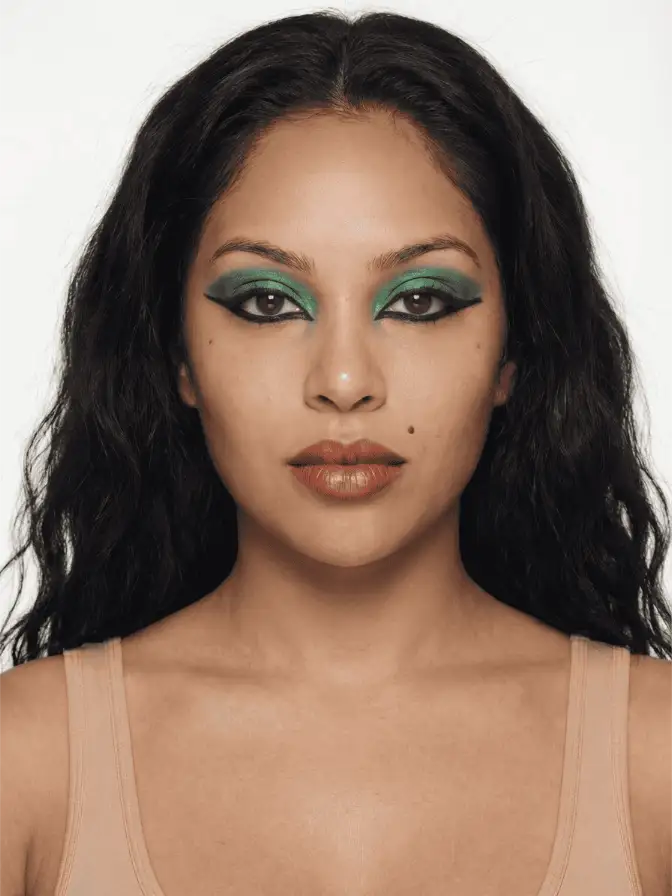
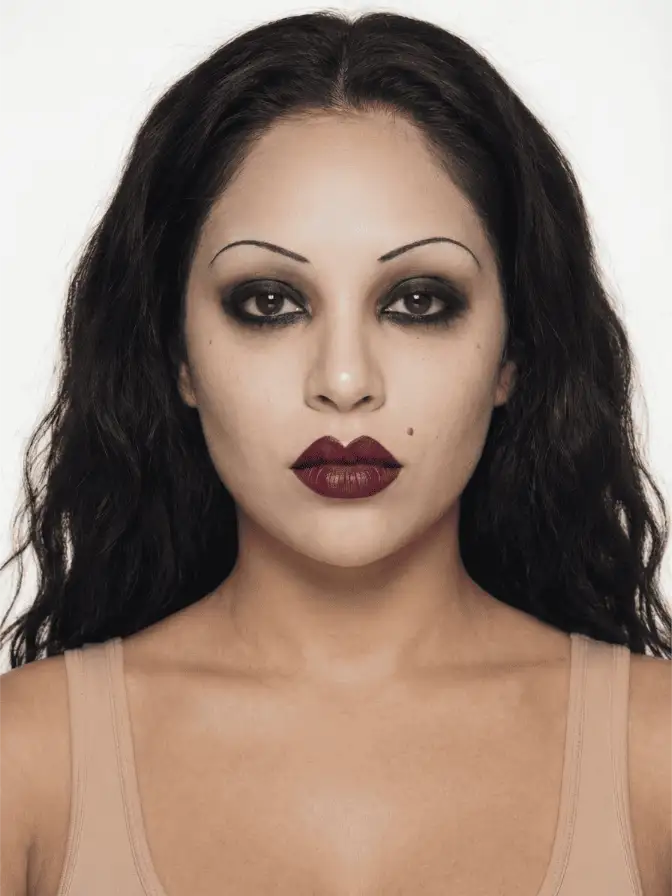
The flapper eye that you see in 1920s portraiture, that the slaye 1920s flapper tutorial reconstructs step by step, is geometrically Egyptian even when it does not look it. The line extends past the outer canthus toward the temple. The waterline is rimmed top and bottom in a continuous loop. The shadow is built in a horizontal band, not a vertical socket.
This is the Egyptian eye, rotated five degrees and translated for European facial proportions. The original kohl makeup, recreated in the ancient Egyptian tutorial, uses galena (a lead sulphide ore) ground with malachite and animal fat. The flapper version substituted carbon black, beeswax, and almond oil. The visual result was nearly identical because the geometry was identical.
Burnt cork remained a common substitute for kohl in households that did not yet have a commercial product. The Smithsonian archive describes women holding cork over a candle, letting the carbon deposit cool, and applying it with a hairpin. This persisted as a technique well into 1925, after which commercial kohl in tin pots had spread far enough that homemade methods receded.
The rouge revolution
Cheek colour in the 1920s is the part of the era’s makeup that modern readers find most foreign. Rouge was applied not as a swept cheekbone definition, the way contemporary strawberry girl makeup places it, but as a circle. A round disc of bright red or orange-red, sometimes the size of a tea cup, placed high on the cheek directly under the iris.
The circle was a deliberate visual decision. Smithsonian’s history notes that the circle “echoed the round flapper eye and the round bobbed hairline.” The face was being designed as a series of geometric shapes, not as a continuous landscape of contour. The doll-like effect was the point. It was a rejection of Edwardian naturalism, the same way the dropped-waist dress was a rejection of the corseted silhouette.
The lipstick that completed the look was applied as a Cupid’s bow, smaller than the actual lip line. The 1929 Tangee Natural lipstick, which famously changed colour on the lip based on pH, became the era’s runaway hit because it gave the Cupid’s-bow effect at a moderate price point. By the end of the decade, Tangee was selling tens of millions of units a year.
Why the Tut effect stuck
Egyptomania as a fashion movement passed within about five years. By 1928, the geometric lacquer Art Deco of the early decade had softened into the longer, looser Art Moderne of late period, and the sphinx-shaped compact had become a kitsch object rather than a luxury one.
But the underlying cultural change held. Cosmetics had crossed the line from shame to glamour. The industry built in the 1923–1929 window survived the Depression, survived the Second World War, and is the direct ancestor of the modern Estée Lauder, L’Oréal, and Revlon corporate structures. Rubinstein and Arden, who founded their houses in this same window, set the template for what a beauty brand looks like.
The Smithsonian’s framing is that the flapper “made cosmetics modern.” The honest version is more specific. A British archaeologist, a Welsh lord, and a 3,000-year-old boy king made cosmetics modern. The flapper just bought them.
Continue reading
- history Egyptian Blue: The First Synthetic Pigment and the Glow It Hid Egypt manufactured a blue pigment 5,000 years ago, then the recipe vanished for a millennium. The strangest part is the glow nobody could see until 2009.
- history Cochineal: the bug that colored your red lipstick The deep red in carmine lipstick comes from a cactus insect the Aztecs taxed and Spain guarded for 250 years. How carminic acid reached your lip bullet.
- history Huadian: The Tang Dynasty Flowers Women Wore on the Forehead Huadian were the painted forehead flowers of Tang dynasty China, born from a princess and a plum blossom. The story runs from gold leaf to dragonfly wings.