Mouches: The 18th-Century Beauty Patch as Social Code
The black silk dots Versailles women wore weren't decoration. They were a coded vocabulary about politics, marriage, and what kind of woman wore them.
A Versailles courtier in 1730 putting on her face for the day would dust on ceruse, brush a circle of rouge high on each cheek, and then reach for a small enameled box. Inside were the mouches, tiny black shapes cut from silk or taffeta, sticky on one side from a mastic gum, ready to be pressed onto the skin in whatever spot the morning’s intent required. The number she chose, and the place she put them, was a sentence other women could read.
The French word means “flies,” which is exactly what they looked like resting on a powdered cheek. They were called mouches in France, patches in England, and neyi by the Russian court that copied the practice from Paris in the 1740s. By the time the fashion peaked in the 1760s, an aristocratic woman might wear five to nine in a single afternoon, and a mouchier, the silver-handled box she kept them in, was as much a part of her toilette as her rouge pot. The Kalmar Antiques piece on Georgian patch boxes notes that the most expensive examples were enameled with miniature portraits, which is to say that the box itself had become a status object.
What each placement actually meant
The vocabulary is documented well enough that the dictionary survives. Geri Walton’s research on French mouches lists at least eight named placements, each with a courtly nickname that doubled as a flirtation tier.
A patch near the corner of the eye was la passionnée, the passionate one. Worn under the lower lip it became la discrète, the discreet, which scholars of the period read as a low-key invitation. La majestueuse sat squarely in the middle of the forehead, la coquette perched on the upper lip, la baiseuse (the kisser) was placed at the corner of the mouth, and l’assassine near the corner of the eye signaled, with characteristic 18th-century melodrama, a woman willing to break a heart on purpose. The placement above a smile line was l’enjouée, the playful, and one tucked into the cleavage was the galante, which needs no translation.
Marriage altered the alphabet. According to several sources, including the Polyester history of beauty patches, an engaged woman wore a heart-shaped patch on her left cheek; once married she moved it to the right. The shift was as legible in a salon as a wedding ring in our own century, and probably more useful, since the engagement-to-marriage gap could span years.
Politics layered on top of the romance. In Restoration and early-Georgian England the patch became openly partisan. Whig-sympathizing women wore patches on the right side of the forehead, Tory women on the left. Joseph Addison wrote a famous Spectator essay in 1711 grumbling that he could no longer attend the theater without first scanning the audience for which faction was in fashion that month, which is a remarkable thing to be able to say about a one-centimeter dot of silk.
Why women picked them up in the first place
The romantic story explains how patches spoke; it doesn’t explain why they appeared. The cosmetic history is less charming.
The 17th century left European women a particularly bad face. Smallpox swept through repeatedly between roughly 1620 and 1750, leaving the survivors with pitted scars on the cheeks, chin, and forehead. The standard cosmetic answer of the moment, ceruse, was a white-lead paste that was sold as flawless coverage and delivered, over time, more scarring of its own. The first beauty patches were not coded flirtation. They were practical scar coverage in materials that didn’t migrate or cake. The Early Modern Medicine writeup on beauty spots traces the shift bluntly: by the 1690s, satirists were already accusing women of using patches “to hide the marks of the French pox,” meaning syphilitic chancres, which puts a different texture on the courtly nicknames.
This kind of double life is normal in beauty history. The Egyptian kohl that I wrote about in the kohl galena chemistry piece had medicinal uses long before it was a status object; the Roman cerussa that poisoned an empire started as honest cosmetic before its toxicity was understood. Mouches followed the same arc. A workaround for damaged skin became a luxury accessory became a vocabulary, all within about three generations.
The mechanics of a 1730s patch
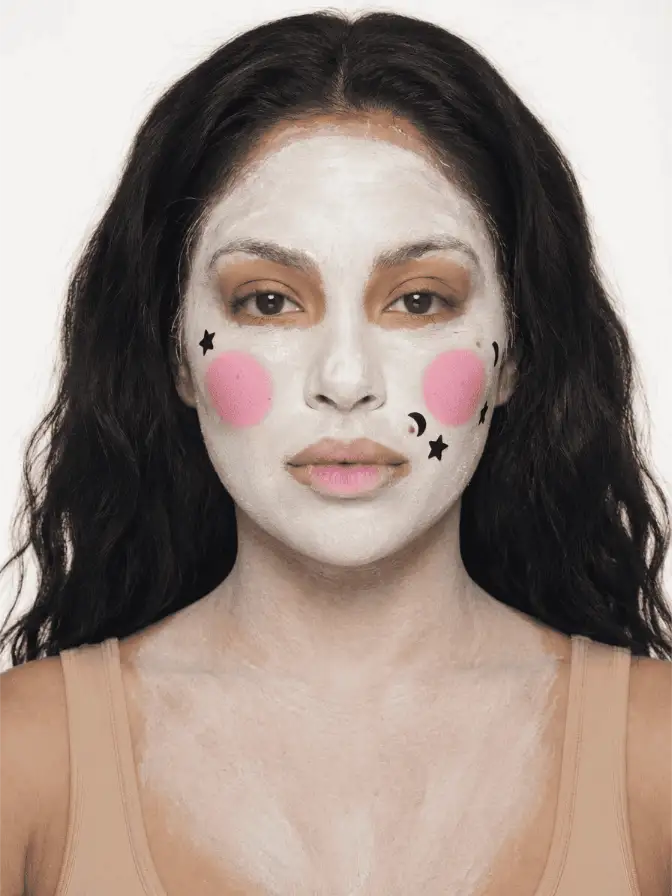
Construction was simpler than you’d guess. Silk taffeta or velvet was cut into small geometric shapes with a stamp or fine scissors. Hearts, crescents, stars, and tiny stylized animals were popular by mid-century; the Messy Nessy writeup mentions courtiers commissioning patches in the shape of carriages, suns, or even tiny human silhouettes for novelty.
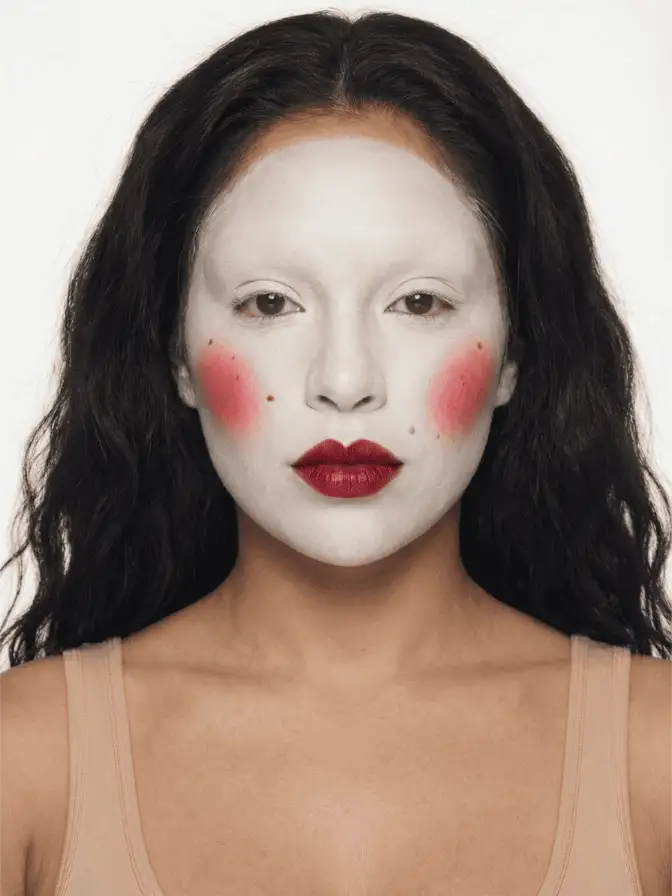
Adhesive was mastic, the same resinous tree sap that varnish-makers used, sometimes mixed with a little honey to make it tackier and more skin-safe. A second-tier option was saliva, applied by the wearer or her maid; this worked but came off faster, which is part of why a mouchier with a fresh supply was carried into the evening. The patch sat directly on top of ceruse or, by the 1750s, on top of a thinner Pearl White or oxide-of-bismuth powder for women trying to avoid lead. The contrast did the rest: deep black silk against chalk-white skin was as visually striking as the kabuki painters were doing on a different continent at the same moment.
For costume work today, recreating the effect doesn’t need mastic. A small dot of liquid eyeliner or a Sharpie-cut piece of velvet held on with eyelash glue will sit happily over a Rococo-style ceruse base, and the look snaps into the period instantly. The placement matters more than the material; a single patch at la passionnée changes the whole read of the face.
The afterlife
The mouche fashion peaked in the 1760s and was already dying by the time of the French Revolution. The reasons are predictable. Patches were intensely associated with the ancien régime aristocracy, and revolutionary France did not want women looking like ancien régime aristocrats. By 1800 the painted face itself was unfashionable; the early-Romantic ideal was natural pallor, and the patches that survived shifted to private theatricals and costume balls.
They came back, in disguise, more than once.
The Victorian-era beauty mark, painted on with kohl rather than glued, is a direct quotation of la coquette and la baiseuse placements, scrubbed of the explicit code. Marilyn Monroe’s mole, partly real and partly enhanced with eyebrow pencil for the camera, sits exactly where an 18th-century courtier would have called it l’assassine. Madonna’s 1980s beauty mark, Cindy Crawford’s, Eva Mendes’s, all of them are patch placements re-read as biographical features.
The Polyester piece argues, persuasively, that the contemporary face stickers and rhinestone-jewel placements that travel along the K-pop and rave-makeup pipelines are the same impulse one more time. A small graphic object, placed deliberately on a part of the face, that other people read as a signal about who’s wearing it. The current vocabulary is different (the placement of a heart sticker over a cheekbone in a 2025 selfie reads as “playful,” not “engaged-but-still-flirting”), but the underlying grammar is recognizable. So is the silver box, lately replaced by a clear plastic compact from a Korean brand, sold for $4.
What it tells us about codes that survive
A coded ornament works as long as everyone agrees on the dictionary. The mouche worked in Versailles because a courtier could glance across a room and parse another woman’s political affiliation, marital status, and intentions in roughly two seconds. It stopped working when the court was no longer the audience and the cipher unraveled into individual decoration.
The honest lesson is that the most striking beauty practices tend to be social technology. A patch is a wearable status message, and so was a Victorian-era trail of dark powder under the eye, and so is, in 2026, a particular shade of red lipstick worn to a specific kind of dinner. The materials change; the way faces talk to each other doesn’t.
Continue reading
- history Egyptian Blue: The First Synthetic Pigment and the Glow It Hid Egypt manufactured a blue pigment 5,000 years ago, then the recipe vanished for a millennium. The strangest part is the glow nobody could see until 2009.
- history Cochineal: the bug that colored your red lipstick The deep red in carmine lipstick comes from a cactus insect the Aztecs taxed and Spain guarded for 250 years. How carminic acid reached your lip bullet.
- history Huadian: The Tang Dynasty Flowers Women Wore on the Forehead Huadian were the painted forehead flowers of Tang dynasty China, born from a princess and a plum blossom. The story runs from gold leaf to dragonfly wings.