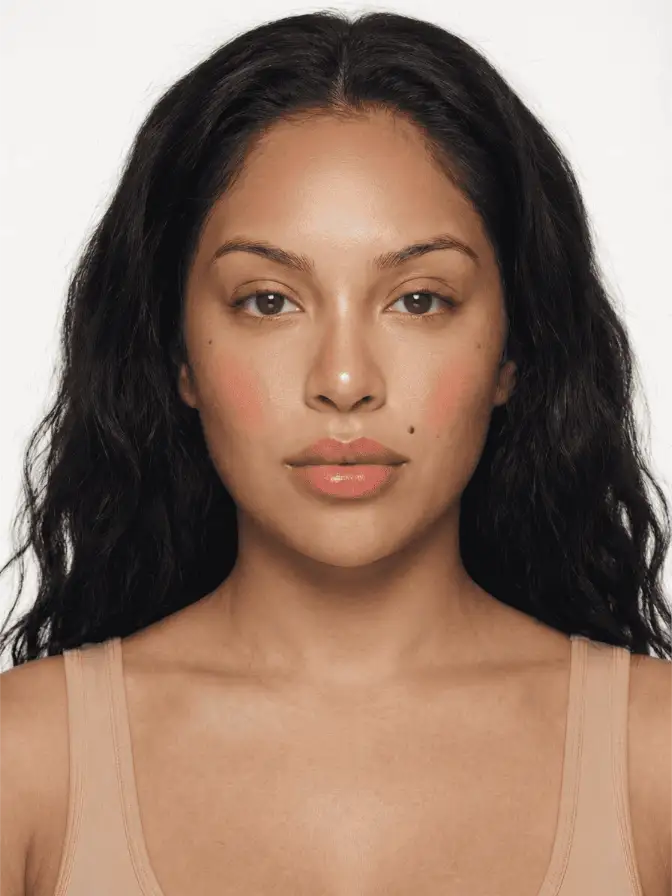
Humidity survival sequence: summer makeup that actually holds
Above 60 per cent humidity, your foundation starts hydrolysing off your face. A specific layering order that survives a 7am commute to a midnight rooftop.
My first summer in Dubai, I lost a full face of makeup between the metro station and my office door. I was wearing a serum-foundation that had survived London winters without complaint. By 8:15am, it was sitting in a beige line along my jaw and the rest had migrated south to my collarbones. I walked into the bathroom at work and started over with a powder I had bought at the airport as a backup.
What I did not understand at the time is that humidity attacks makeup chemically, not just by making you sweat. When ambient relative humidity climbs above about 60 per cent, two things happen at once. The skin produces more sebum (a temperature regulation response), and the binding agents in liquid foundation, mascara, and cream blush start to absorb atmospheric water. Both phenomena are described in Kathleen Jennings’ makeup-for-humidity essay and corroborated in Lancome’s own humidity research. The result is that your foundation behaves as if you had thinned it with water, then your own oils dissolve the thinned film, then everything migrates.
What follows is the sequence I have settled on after six summers in Dubai, two in Singapore, and a recent visit to Mumbai during monsoon. It is not optimal for every face. It is optimal for the question: what survives a 7am commute, a fluorescent-lit office, an evening commute back through 90 per cent humidity, and an outdoor dinner at sundown.
Step 1: a barrier, not a hydrator
The first instinct in hot weather is to skip moisturiser. Resist this. Skin that is acutely dehydrated produces more oil, not less, and oil is the solvent your foundation will dissolve in. What changes is the type of moisturiser.
In humid weather I switch from my usual glycerin-rich morning cream to a thin layer of a film-forming gel: La Roche-Posay Effaclar Mat is the one I have used longest, Beauty of Joseon Matte Sun Stick over it. The first product matifies and reduces the next four hours of oil production; the second is a high-SPF physical sunscreen that doubles as a primer because of its solid film. Both contain very little glycerin or hyaluronic acid, because those humectants pull moisture out of damp air and onto your face, which is the opposite of what you want.
Skip serums entirely on humid days unless you have a specific clinical reason for one. The barrier layer should be three products at most: a thin gel, a sunscreen, and a primer if you wear one. Anything more and you are stacking water-soluble actives that will start to migrate the moment you sweat.
Step 2: a water-based foundation, applied thin
This is the step most people get wrong. The instinct is to reach for a long-wear, full-coverage liquid (Estee Lauder Double Wear, Make Up For Ever HD Skin). These will work, but only if applied much thinner than the brand recommends.
A useful rule: two pea-sized drops for the whole face, applied with damp fingertips, then pressed (not buffed) into the skin. Buffing breaks the film. Pressing seats it. If you need more coverage on a specific area (a redness patch, a dark mark), build with concealer rather than more foundation.
The reason water-based formulas beat silicone-heavy ones in humid weather is structural. Silicone-based foundations form a continuous film that traps sweat underneath; once a single break appears, the whole film slides. Water-based foundations dry to a thinner, more breathable layer that lets sweat evaporate through it rather than pooling. The trade-off is that water-based formulas need to be set immediately or they will transfer onto a collar.
Step 3: bake the T-zone, not the cheeks
Baking, the technique of applying a heavy layer of translucent powder and leaving it for five to ten minutes before sweeping it away, works in humid weather but only on specific zones. The forehead, sides of the nose, and under the eyes can take a thick bake; the cheeks and jawline cannot.
The Red Apple Lipstick humidity guide recommends Coty Airspun for the bake, which I would second. Laura Mercier Translucent is a more refined finish but does not absorb oil as aggressively. Apply with a damp sponge so the powder sets into the foundation rather than sitting on top of it. Set a five-minute timer. Sweep away with a fluffy brush.
The reason this works: the powder absorbs the first wave of sebum your skin produces (the heaviest one, usually within the first hour after application) and locks it into a matte film, which then acts as an oil-blotting layer for the rest of the day. The reason you skip it on the cheeks: powdered cream blush turns muddy when wet air hits it. Cream products on the cheek should stay cream.
Step 4: cream blush, sealed with powder
The trick that took me longest to learn. Apply a cream or liquid blush (Rare Beauty Soft Pinch Liquid Blush is the benchmark; Tower 28 BeachPlease is a good cheaper alternative) over the foundation but before any powder on the cheek. Then dust a tiny amount of a matching powder blush over the top, in the same shade family.
The cream layer gives the colour staying power, because pigment held in oil binds more permanently to the skin than pigment held in talc. The powder layer prevents the cream from going tacky when sweat hits it. Together they survive eight to ten hours of moderate humidity, which is more than any single product on its own.
This double-layer logic is the same one used in the no-makeup-makeup tutorial and a more polished version of the vacation resort tutorial. It is also the way most professional artists do red carpet faces, which is the highest-stakes humidity test in the industry.
Step 5: setting spray, with the right technique
Setting spray in humid weather is the single most misunderstood product in a summer routine. The standard advice (mist liberally after makeup) makes things worse. What works:
Hold the bottle 30 cm away (further than the brand says). Mist once across the upper face, once across the lower face. Wait one full minute. Mist again, same coverage. The two-pass technique gives the film former (the active in Urban Decay All Nighter, Charlotte Tilbury Airbrush Flawless, Skindinavia The Makeup Finishing Spray) time to bond with the powder layer underneath.
Avoid sprays with glycerin or sodium hyaluronate as the primary humectant. These read as hydrating, which sounds appealing on a hot day, but in humid air they actively pull water into the surface of your makeup. Mac Fix+ is the most-cited offender. Save it for dry climates.
What to carry for the touch-up
Two products in your bag, no more. A small compact of pressed powder for the T-zone (Hourglass Veil Translucent is the one I have not lost in three years) and a single sheet of oil-blotting paper folded into your wallet. That is it. Do not carry foundation or concealer for a touch-up; trying to re-layer either over an already-sweating face creates the streaky beige jaw I described at the start of this piece. Blot first. Powder second. Stop.
If you want a refresh after work, a post-workout style reset is faster than a full redo. Press a damp cotton round across the cheek to remove the powder, re-apply a single cream blush, and add a gloss. Five minutes.
The whole sequence above takes about twelve minutes once you have practised it. It survives my Dubai summer commute most days, and on the days it does not, I know which step I rushed. Usually the cream-blush-under-powder seal. The face that survives humidity is not the face you put on slowly. It is the face you put on in the right order.
Frequently asked
Does setting spray actually work in humidity?
Yes, but the type matters. Film-former sprays (Urban Decay All Nighter, Charlotte Tilbury Airbrush Flawless) outperform glycerin-heavy ones in high humidity, because glycerin pulls extra water out of the air and onto your face. Two light mists work better than one heavy one. Hold the bottle further away than you think (about 30 cm).
What foundation lasts longest in humid weather?
Powder and water-based liquid formulations beat oil-based and silicone-heavy ones in high humidity. Estee Lauder Double Wear (water-based) and Kosas Revealer Skin (light, water-based) both hold past nine hours in 70 per cent humidity for me. Avoid anything labelled luminous or dewy, those have humectants that swell when wet air hits them.
Should you bake your makeup if it's humid?
Yes, but only on the T-zone and under the eyes, not the whole face. A heavy bake on the cheeks creates a thick powder layer that turns gummy when sweat hits it. Use a translucent powder (Laura Mercier or Coty Airspun), apply with a damp sponge, leave for five minutes, sweep away the excess.
Continue reading
- routines The Interview Face: Five Products That Read Competent on Camera A hybrid interview means makeup that survives a flattening webcam and harsh office light. Five products, structure over coverage, matte where the camera bounces.
- routines Festival makeup that survives three days of heat A realistic kit and a sweat-proof sequence for multi-day outdoor festivals: thin cream-then-powder layering, the setting-spray sandwich, and the lash call.
- routines Makeup for Glasses, Sorted by Your Prescription Minus lenses shrink the eye, plus lenses magnify it. Two short makeup routines built around that one optical fact, with finish choices and a brow note.