Copper peptides (GHK-Cu): what 4,000 genes actually do
GHK-Cu has the deepest research dossier in cosmetic peptide science. The data is real, the optimal dose is low, and the marketing rarely tells you the second half.
GHK-Cu is the most over-researched peptide in cosmetic chemistry. The dossier started in 1973, when Loren Pickart isolated it from human plasma and noticed it accelerated wound healing in liver cell cultures. Fifty years later, the published literature on this three-amino-acid copper complex runs to several hundred peer-reviewed papers, more than any other peptide currently used in skincare.
The marketing line, repeated across every brand that uses it, is that GHK-Cu “activates over 4,000 genes.” That number comes from a 2010 transcriptomic study and is, technically, accurate. The half of the story rarely told is that some of those genes do the opposite of what you want.
What the molecule actually is
GHK-Cu is glycine-histidine-lysine, three amino acids in a fixed sequence, coordinated to a copper II ion. In its free form the peptide GHK is unstable and gets chewed apart by skin enzymes within hours. The copper changes that. Once GHK binds copper, the complex resists hydrolysis long enough to penetrate the stratum corneum and signal to fibroblasts in the dermis below.
The 2010 in vitro skin penetration study at PMC measured copper tripeptide delivery across human epidermis as a function of vehicle and layer. The headline finding: GHK-Cu does penetrate to the dermal-epidermal junction in measurable quantities when formulated at 0.5 to 2 percent in a humectant-rich vehicle. That penetration is the entire point. A peptide that sits on the corneocyte surface does nothing.
The 4,000-gene claim, with the asterisk
The transcriptomic paper everyone cites measured fibroblast gene expression after GHK exposure and found roughly 4,192 genes shifted by 50 percent or more from baseline. Of those, about 4,000 were upregulated and around 200 were downregulated. The pathways that lit up most reliably included collagen I and III synthesis, decorin production, dermal stem cell stimulation, and a constellation of anti-inflammatory cytokines.
The downregulated set is the bit nobody quotes. It includes about a hundred pro-inflammatory genes, which is good news. It also includes a handful of pigmentation pathways, which is partly why GHK-Cu has a small but reproducible brightening effect.
The complication is dose-dependent. At low concentration, GHK-Cu primarily switches on collagen synthesis. As concentration climbs above roughly 2 percent, it also begins switching on the MMP-2 gene, which codes for a matrix metalloproteinase that breaks collagen back down. The Asterwood 2026 guide describes this as the “hormesis curve” of the molecule. More is not better. It is, at a certain threshold, actively worse.
This is why brand chemists targeting genuine efficacy stay at or below 1 percent. The Ordinary’s Multi-Peptide and Copper Peptides 1% serum lists GHK-Cu at exactly that ceiling and pairs it with eleven other peptides specifically because stacking different signaling pathways at low individual doses beats hammering one pathway at high dose.
The clinical data, briefly
A pilot study referenced in the Private Label Labs roundup measured visible outcomes from topical GHK-Cu over twelve weeks. Wrinkle volume dropped by 31.6 percent versus a Matrixyl 3000 control, epidermal thickness increased, dermal elasticity measurably improved.
These are real numbers, but they sit in a study with about thirty participants and an industry sponsor. The right way to read them is as a directional signal, not a guaranteed personal outcome. What the broader literature consistently shows is that GHK-Cu does measurably increase procollagen and elastin synthesis in cultured fibroblasts at low micromolar concentrations. The bench data is overwhelming. The clinical data is encouraging but smaller than the bench data implies.
Layering, and the vitamin C problem
The single biggest formulation pitfall with copper peptides is mixing them with reducing agents. L-ascorbic acid, the active form of vitamin C, will chelate copper away from the GHK ligand and produce a complex that does nothing for your skin. The visible sign is a yellow stain where the two layers met. The functional sign is no benefit from either active.
This is not a theoretical concern. It happens in real life when someone layers a 15 percent vitamin C serum directly over a copper peptide serum in the same routine. The fix is straightforward: vitamin C in the morning routine, GHK-Cu in the evening routine. Or, if your skin tolerates both in one sitting, twenty minutes of buffer time between layers and a humectant in between.
GHK-Cu plays better with retinoids. The copper ion does not interfere with retinol oxidation, and the anti-inflammatory pathways GHK-Cu switches on partially blunt the irritation cascade retinol triggers. This pairing shows up in serious formulator decks as the foundation for an anti-aging routine. The Allies of Skin Copper Tripeptide and Ectoin serum builds on exactly this logic, pairing GHK-Cu with a stress-protective osmolyte rather than a competing signal molecule.
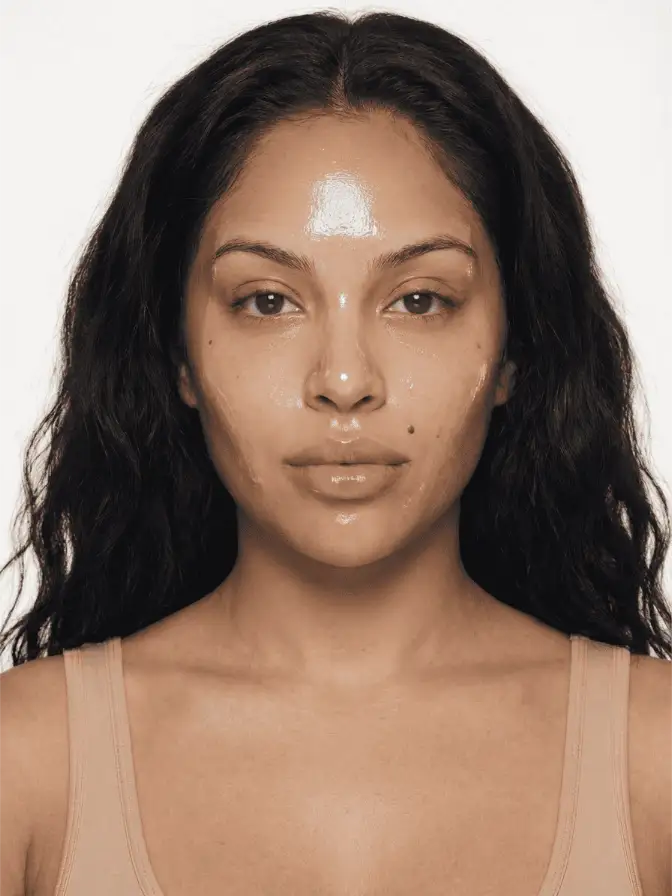
For makeup readers, the connection to slaye’s editorial is straightforward. The reason a glass-skin finish holds for hours rather than minutes is that the underlying skin barrier reflects light evenly. GHK-Cu does not produce that finish on its own. What it does is improve the dermal scaffolding underneath, so the surface you eventually polish is structurally sound rather than dehydrated and patchy. Foundation choices, dewy underpainting, and the rest of the application sequence still matter. The peptide is a long game.
What to buy, what to skip
The buy list is short. Anything in the 0.5 to 1 percent GHK-Cu range from a brand that publishes concentration data. The Ordinary’s 1 percent serum at around fifteen dollars is the entry point. Allies of Skin’s blend at around ninety dollars adds ectoin and silver-blue packaging to the same active. Niod’s Copper Amino Isolate Serum is the heaviest in the category at over 2 percent total copper peptide load, which puts it above the comfortable hormesis threshold.
The skip list is longer. Anything that doesn’t disclose the copper peptide percentage. Anything blue-green in color from copper sulfate rather than a coordinated peptide complex. Anything that promises “instant” anything from a peptide. The signal pathways GHK-Cu activates take twelve weeks to show up in a face. They cannot be hurried.
The molecule is not magic. It is well-characterized chemistry with a known dose-response curve, sitting in a category where most actives are far less rigorously studied. That alone makes it worth the routine slot.
Frequently asked
Can I use copper peptides with vitamin C?
Not in the same step. L-ascorbic acid chelates the copper ion, knocking the GHK-Cu complex apart and producing a watery yellow stain on the skin where the active should be. Apply vitamin C in the morning and GHK-Cu at night, or wait twenty minutes between layers if you must stack them in the same routine.
What percentage of GHK-Cu actually works?
The literature points to 0.05 to 2 percent as the effective window. Higher concentrations switch on the collagen-degrading enzyme MMP-2 along with the synthesis pathway, partially undoing the benefit. The Ordinary's 1 percent and Allies of Skin's blend sit in the sweet spot.
How long until copper peptides show results?
Hydration and barrier feel improve within two weeks. Visible texture and fine-line changes take eight to twelve weeks, matching the timeline for new collagen to organize itself in the dermis. Anyone who claims faster results from a topical peptide is selling something.
Continue reading
- product-science Acetyl Zingerone: The Ginger Antioxidant That Works After Sundown Acetyl zingerone keeps blocking UV-triggered DNA damage in skin cells for hours after the sun sets. Here is what the antioxidant data actually shows.
- product-science Ergothioneine: the mushroom antioxidant with real data Ergothioneine rides a dedicated transporter into skin cells that vitamin C cannot reach. A look at the mechanism, the clinical data, and the longevity hype.
- product-science Kojic Acid for Hyperpigmentation: How Copper Chelation Works Kojic acid blocks pigment by starving tyrosinase of its copper cofactor, a different route from arbutin or vitamin C. Here is the evidence, the dose, the catch.